Journeys End

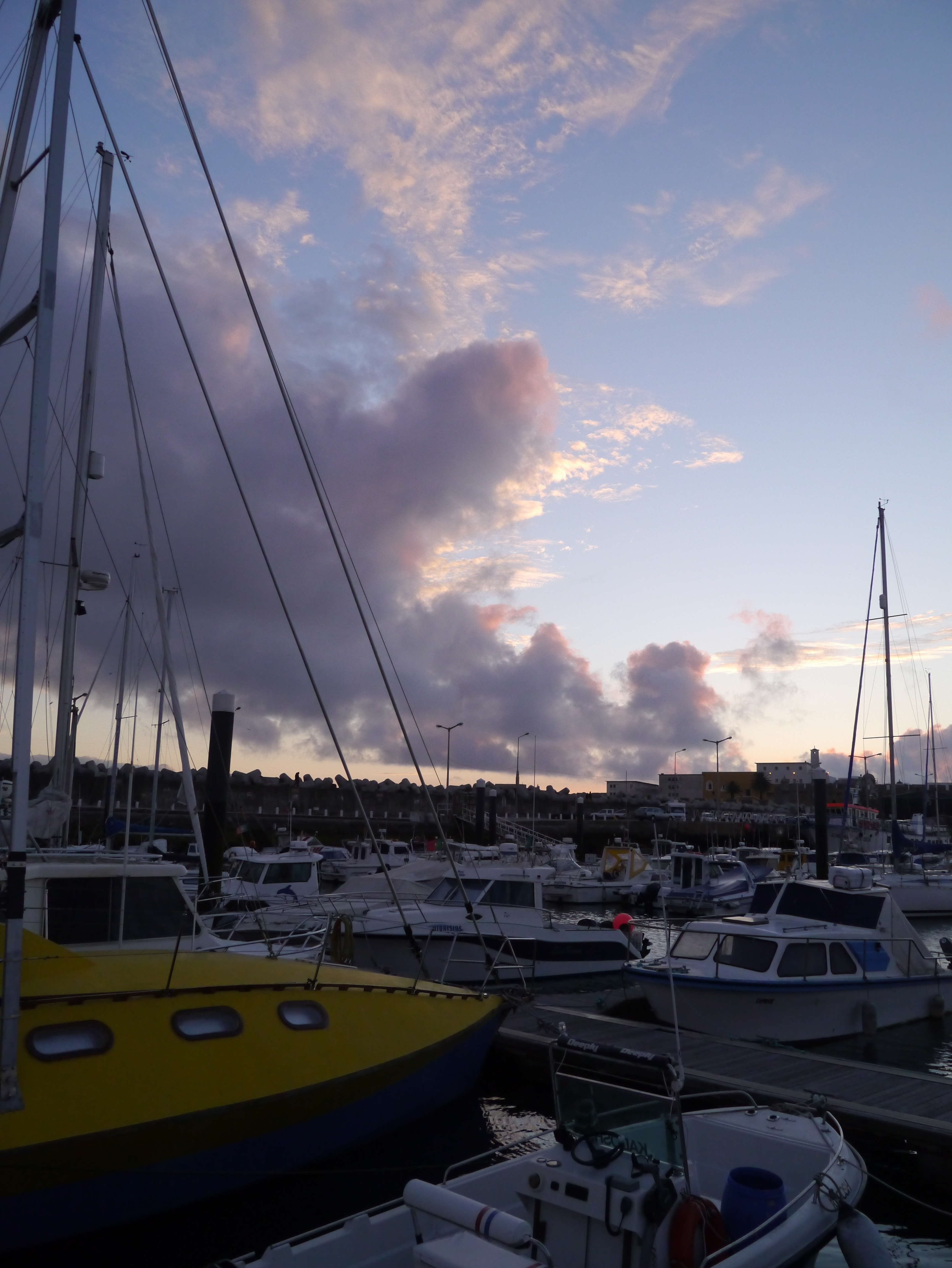
The final leg of our journey this year was a voyage of some eighty miles to Lagos, where we are to overwinter. It involved going round Cabo de Sao Vicente, the other end of the earth. We set off at dawn. All was quiet and still, but there were stirrings along the pontoon as the two Dutch boats we have been threading our way along the coast with were also setting off. Seadrive was out before us and looked pretty in the early morning light as we passed her. SeadriveThe wind did not blow as forecast and yesterdays unscheduled blow had set up a robust swell, which I struggled with. Hours passed. We saw a couple of dolphin, but they were busy fishing and stayed in our wake. Finally the Cape crept closer and as we rounded it the wind came up and our hearts rose at the prospect of a nice final sail, a fast reach into Lagos. The wind promptly died. The same could not be said for the swell.

Cape St VincentThe Atlantic swell met big waves coming out from the east and set up a lively interference pattern. Lyra rode it all, but it was not the most comfortable of passages.

Footbridge, Lagos

The entry into Lagos is up a long walled passage at the end of which is a lifting foot bridge, where boats have to radio in and wait for it to open before they can pass through into the marina. It brought back worrisome memories of queuing for locks, long ago on our holiday with Mum and Dad on the Caledonian Canal. Fortunately it all went well. We tied up at around six thirty. It felt like a very long day. Next day we met up with the crew of Seadrive. They had planned to anchor off behind the Cape, but had decided it was untenable in the chop. They were moving on that day towards Alicante. We wished them better winds and calmer seas. That will be us next year.

Lagos seems overrun by us foreigners, at least as far as we have seen. English girls are waitressing in the bars and all manner of British food is on offer. A stepping stone to home. We are spending a few days settling the boat down before flying back on Wednesday.

Posted in Sailing | Tagged , | Leave a comment

Home Towns

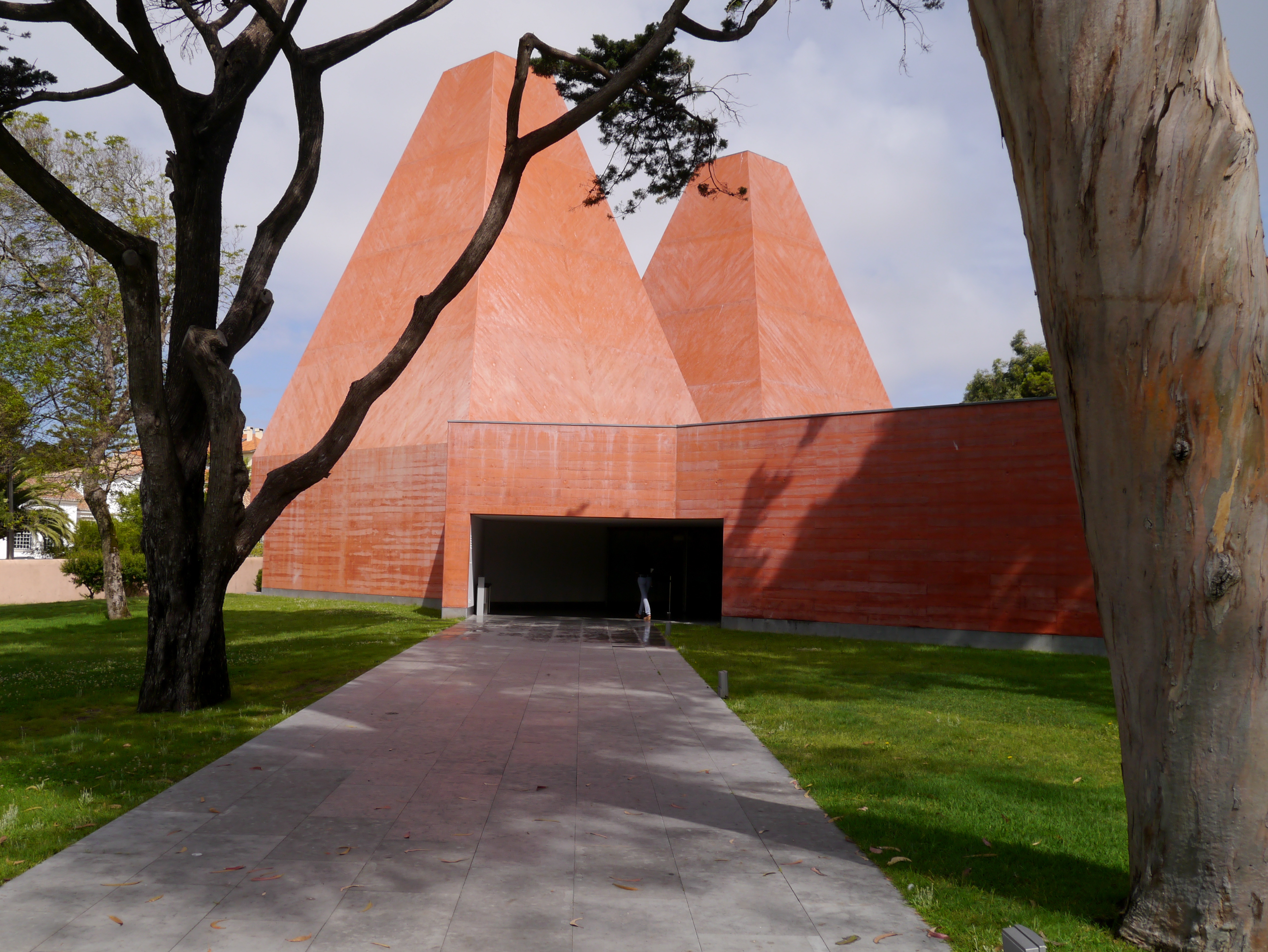
To recap on our time in Cascais before our encounter with whales, one artist whose work we somehow missed seeing at the Berardo collection was Paula Rego. One of the features on our map of Cascais was the Casa das Historias Paula Rego. It was not far from the marina, so before we left for Sines, we decided to incorporate it on our walk to see Hells Mouth, a rock formation just up the coast. We were not sure what to expect, for all we knew there was just a house with a plaque saying Paula Rego lived here on it, but it was worth a shot. RoosterTo get there we walked through the park at the side of the marina car entrance and were serenaded by the vocal duelling of the resident roosters. The Casa turned out to be another very impressive art space, Casa das Historias Paula Regohouse in a modern building that looked inspired by pottery kilns.

The exhibition we saw was based on work inspired by the librettos of operas, with the characters depicted as animals and sometimes fruit. There were some very witty characterisations, but while it was good to see the studies made in preparation, it seemed to weaken the presentation to give over so many large rooms to them. Still I should hardly complain, it was a lot better than just a plaque on a wall and free to view.

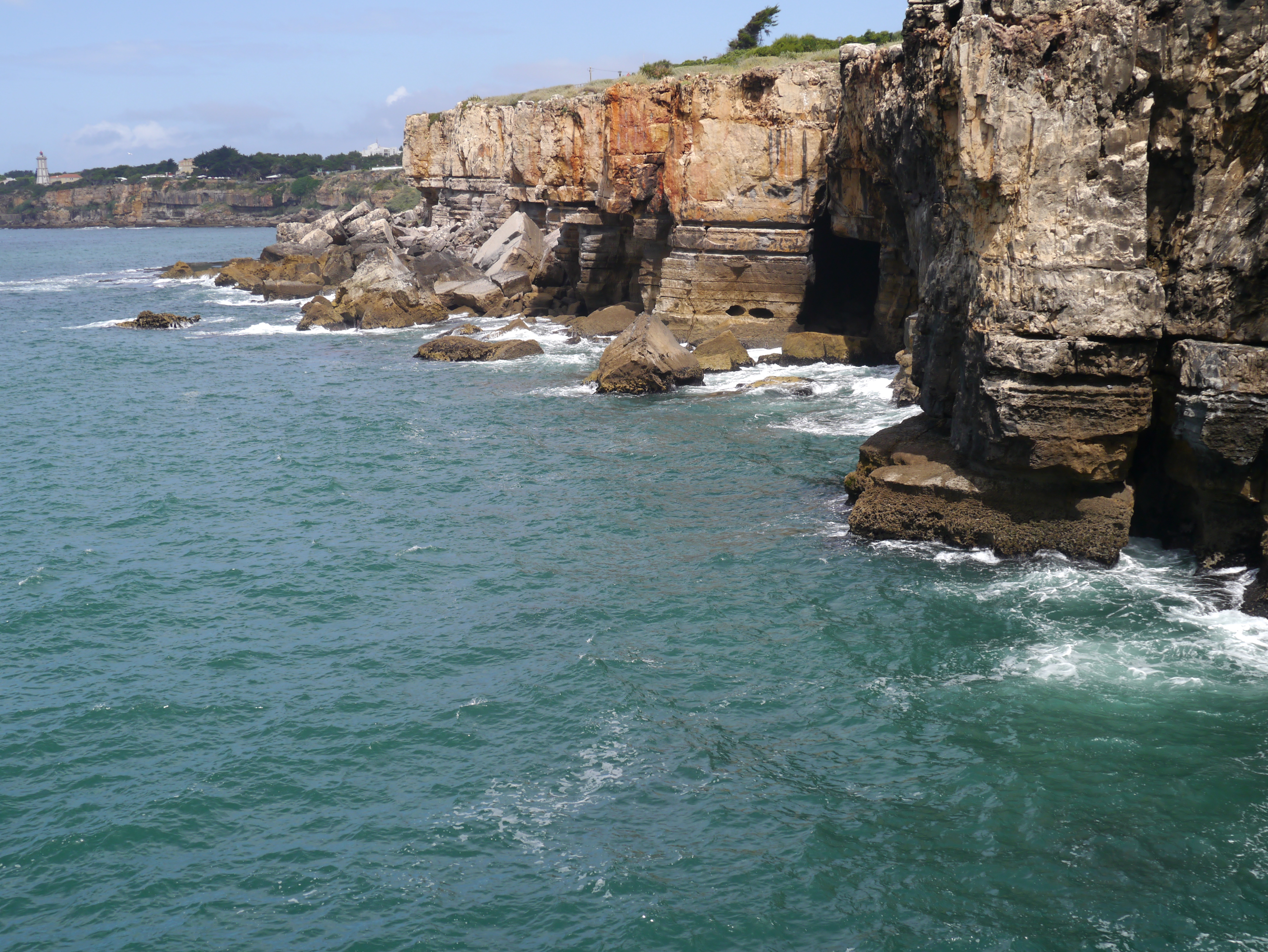
Boca do Inferno, Hell’s Mouth is an impressive rock arch in the cliffs immediately beside the marina. View from above Hell's Mouth

Out to sea we spotted the gaff rigged boat that is moored at the end of our pontoon taking trippers to see the arch from the water, after which they raised the sails and took them out along the coast the other way. We were back at the marina long before them, so it seemed a worthwhile trip.

This slideshow requires JavaScript.

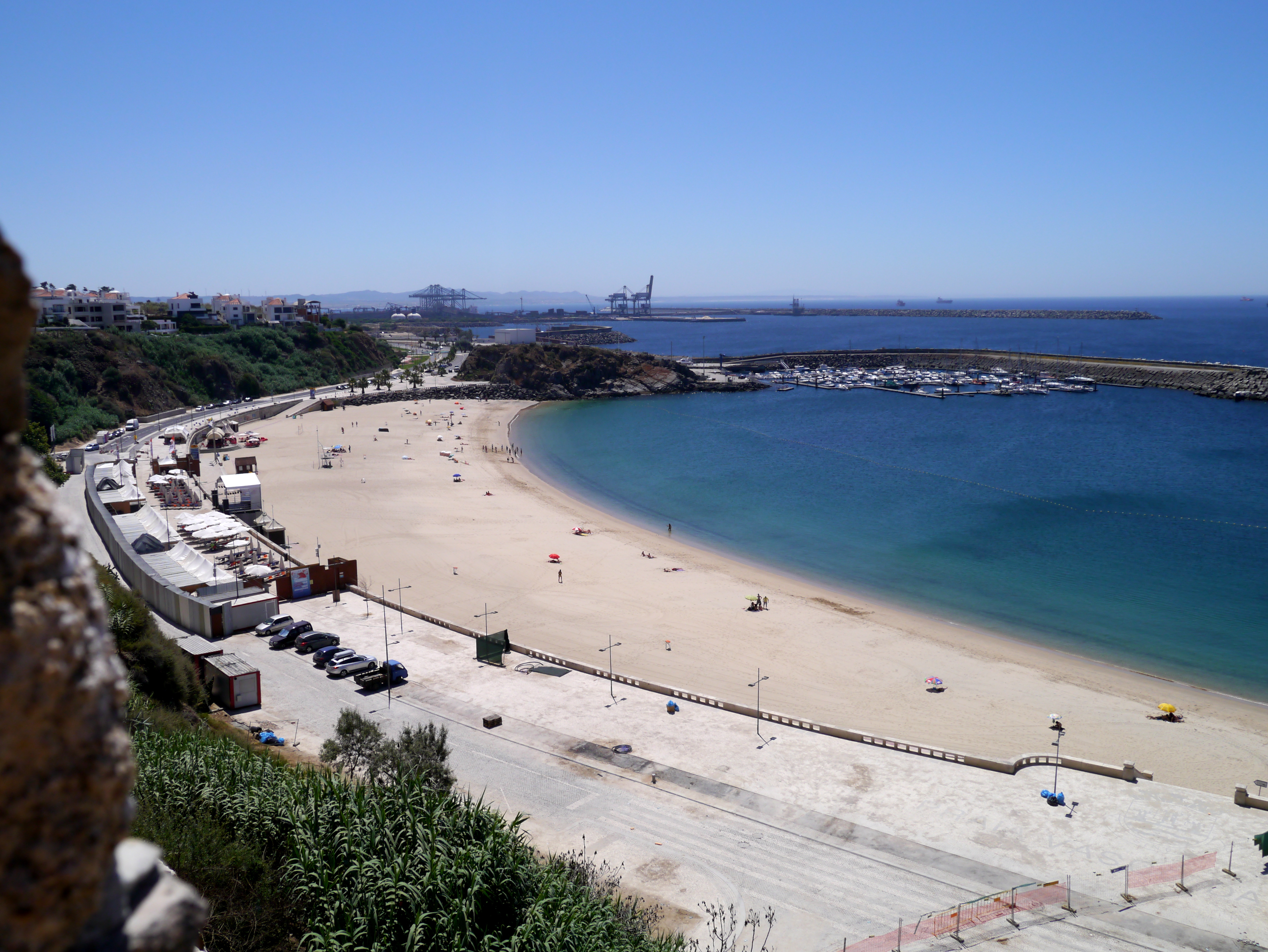
We had an early night for next day we were off to Sines, birthplace of Vasco de Gama. I have already posted about our whale spotting en route as I could not wait. Sines is the oddest place we have been so far. There are oil refineries, some burning off gas and quite a lot of industry to see on the approach. Once in the harbour this is all masked by the town. This looks picturesque, ranged round the walls of an old fort on the cliff tops behind a flawless beach named after Vasco and overlooked by an impressive statue of him. The marina is tucked behind one harbour wall overlooking the beach and a fishing dock is across behind the opposite one. There was no VHF channel on which to contact the marina, but three marineras were waiting to direct and help people as they arrived, probably on account of the wind. The marina headquarters is new and everyone was most helpful. There was information about the extensive marine conservation activities that went on here. So far so good.Sines

We walked into town along the beach and then up a steep winding road. It had no obvious centre and was not particularly attractive on close inspection as many buildings were rather run down. Further through there was a dramatic change to glossy new paving and a huge square modern building with no windows made from the same pink slabs as the paving. It was like walking into a Dr Who set where aliens had landed and set up a different civilisation surrounded by a high wall. The building houses a library and an art centre and was a clone of the building that housed the Barado collection, but here it looks much more dominant and out of place. It is as though money has been ladled into one building while all around it is chaos and lack of investment. We had a lovely meal in the restaurant by the Fort, but had only managed to find one restaurant amongst the smaller bars. Further exploration next day took us through some luxury apartments, all empty, through some rather nice town houses and then back into the warren of dilapidated streets. It has the atmosphere of the deserted Olympic venues in Greece. Inside the fort, SinesThe fort itself was impressive on the outside and the walls hung with streamers of fairy lights, but inside was a barren space, which had obviously held an event, the detritus of which was left lying around.

Our next leg was a really long one, so we had stayed in Sines two nights to rest up and because there was better wind forecast for the following day, but all in all we were ready to move on.

Posted in sight seeing, Walking | Tagged , , , | Leave a comment

Whales!!!

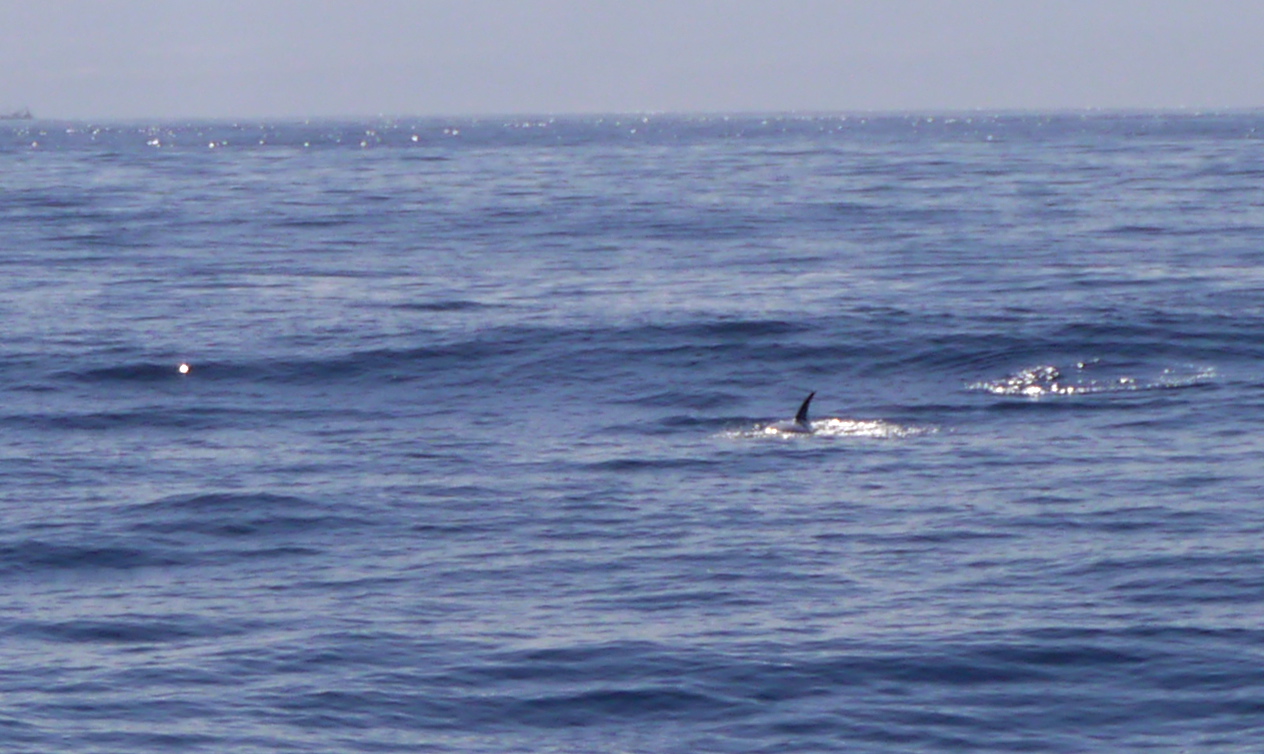
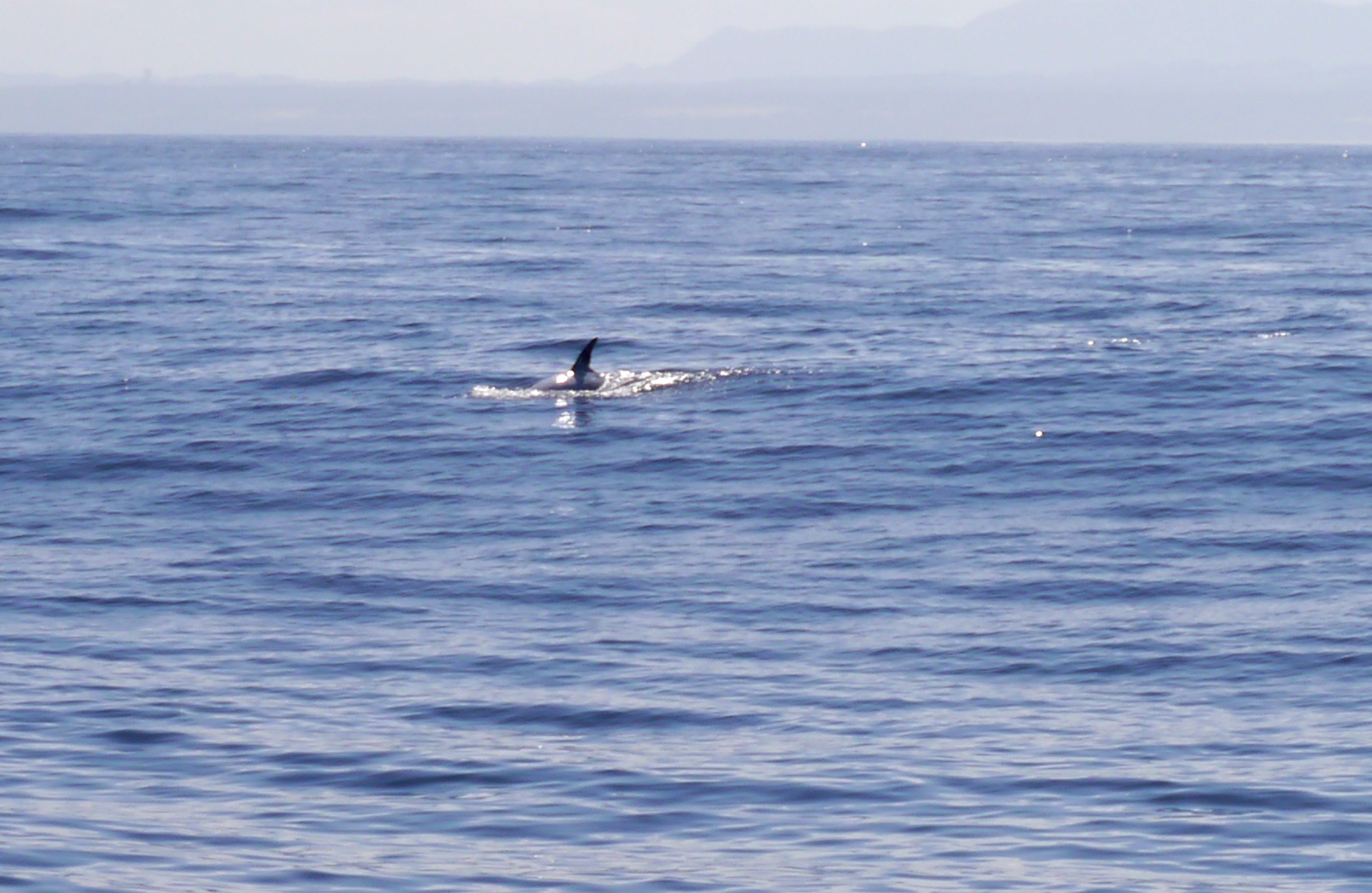
You may well think this is a dolphin. That is what we thought when we first spotted it. You would be wrong, this is a whale, the two sets of ripples both belong to one animal. WhaleJohn pointed out a big disturbance in the water and a large sleek back with a dorsal fin. It looked out of scale, too big. Then as it dove we saw the length of the back and the knuckle shape with the small fin further down the spine. Its movement was more deliberate than that of dolphins and it was coming our way. This did not seem to be because it was seeking us out, but more as though it was maintaining a course. It looked to be about half the size of Lyra. As we watched we realised there were two travelling in parallel, one barely crested the surface, but spouting water and the original one, showing itself more, but further away. WhaleFrustratingly I did not manage to capture a very clear image of either. After they had passed we saw more spouting on our stern quarter. We had been traveling in deep water and the depth gauge stops coping and just flashes the last depth it has recorded. When we looked it was flashing twelve meters, not a hundred and twenty as we had thought. That was not the end of the whale spotting though.

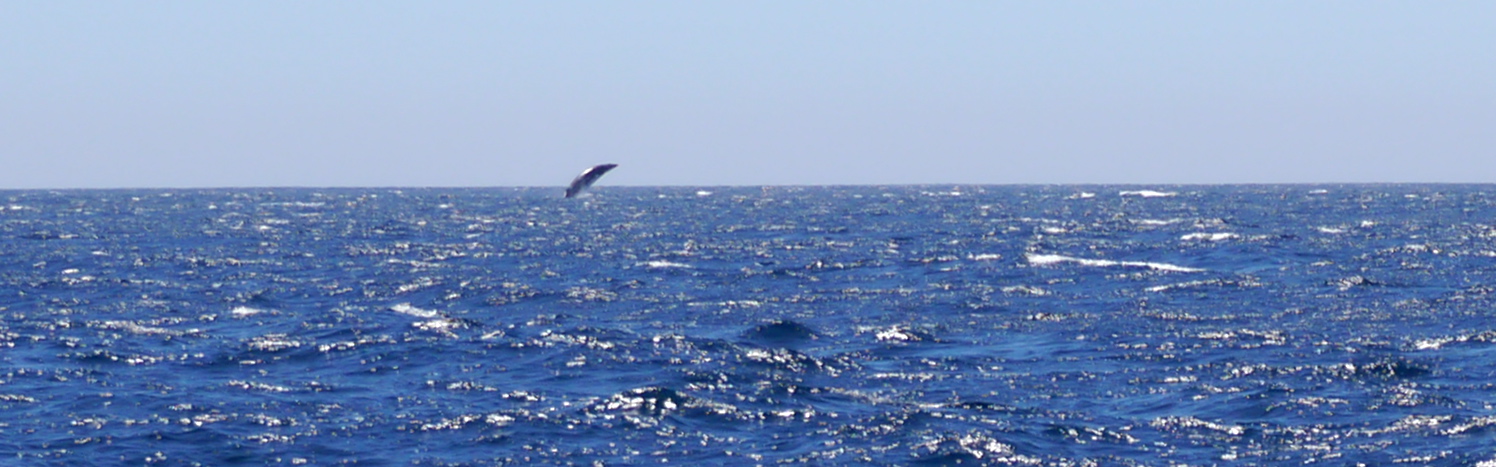
We carried on motoring towards Sines and it was only in the last hour that the wind came up. The water became more choppy with lots of white horses. Then John noticed a really big area of splash out near the horizon and as we watched we saw another whale. It was along way off, but when we saw how it was performing we decided that was not such a bad thing. It was breeching, jumping entirely out of the water, seeming to hang in the air and then crashing back down. Not just once or twice either, it was travelling along in this way, twisting in the air, so that we could see the sun gleaming on the white underbelly, disappearing into the splash and then surging out again further on. It is hard to gauge, but this looked to be a lot bigger than the whales we had seen earlier. Sometimes it seemed to cross back on itself, so there may have been more than one.

Another breechWhale splashA splash near the boat made both of us jump in the air, but it was just a wave hitting the wake. The whole experience was much more awesome than I can hope to convey.

Posted in Sailing, Wild life | Tagged , | Leave a comment

Lisbon

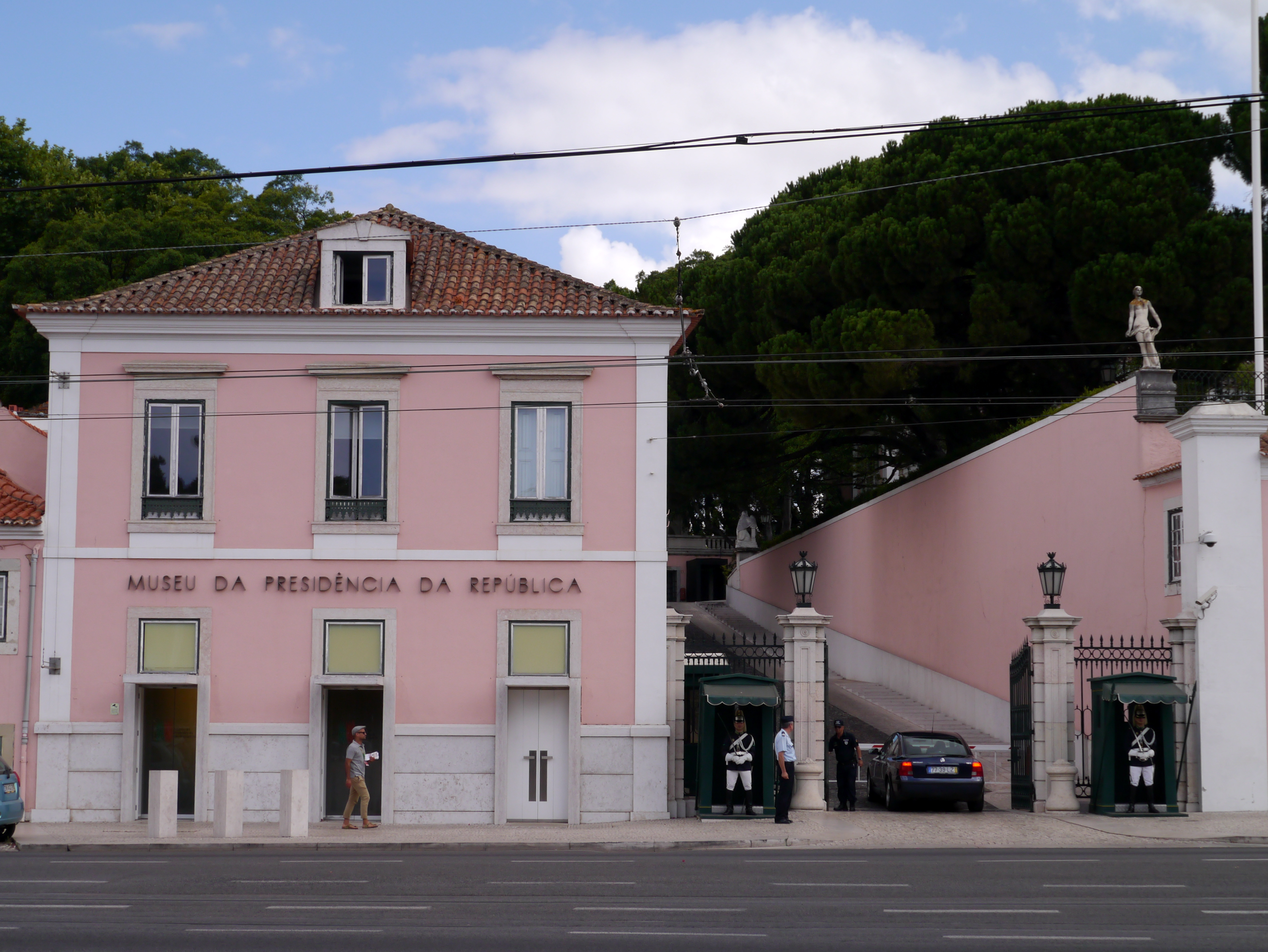
For the past two days we have been playing proper tourists, seeing the sights of Lisbon. Originally we planned just one day. Lisbon being such an historic city, older than Rome, there was little chance of us managing to do it full justice. John did some research and decided we should concentrate on the Belem area. Even doing this we still did not manage to see everything there and definitely needed the extra day. We have taken the in train both times. Presidents HouseOn the first journey our train sailed straight past Belem, despite the fact that it is the focus of tourist attractions.  We went on a couple of stops to the end of the line, disembarked, consulted the billboard and stepped back onto the same train, which duly pulled up at Belem on its way back. At least at the end of the day we knew where to get on, but that train stopped after only a few stations and everyone got off. Prompted by a thoughtful fellow passenger we followed suite. Another train pulled up alongside and we all climbed in and completed our journey. Most odd. The following day the train out stopped at Belem on our way there and the train back went all the way to Cascais.

On our first day we visited the Mosterio dos Jeronimos, a huge ornate building like a white version of the Palace of Westminster. It is five hundred years old and has been both a religious and a civic site of importance. Vasco de Gama prayed there before setting off for India and has been duly granted tomb space. As we approached the Monastery we passed a large restaurant with a long, unruly queue outside, odd at such and early time on a weekday morning. We could only assume that it had a local reputation for being the place to buy the traditional custard tarts. Next door but one to it was Starbucks, with no queue whatever and round the corner from that an old street tram serving coffees was surrounded by deserted tables. The tops of which were printed with rather handy maps. Startlingly, a tram service was still running right up to the café car. Primed with the need to get on we hurried past all of these refreshment stops in favour of the Monastery.

We bought tickets and explored the ornate cloisters, which were on two levels. It was rather like wandering around an elaborately iced wedding cake. On the ground floor one side housed the vast, tiled, rather dank ancient refractory, another side held an exhibition around the tomb of a famous Portuguese liberal thinker, writer and politician, Alexander Herculano. He had been the librarian here and there were signs for the ancient library, I was excited by the prospect of old books. On the next side of the cloister stood a row of black doors, each with differently carved surrounds, most were small confessionals, but the first door in the line opened on to a vast staircase, designed to travel the full length of the cloister in order to mount its’ soaring arches. This lead to the upper storey and, it promised, the ancient library. By turning left at the top of the staircase we found ourselves on a balcony looking down into the cavern of the cathedral part of the monastery. The roof soared even higher on slender, white pillars, ghostly in the dim light of the tall stained glass windows. Back at the top of the stairs we took the right turn out onto the upper storey of the cloister. The library aptly occupied the space above Herculano’s tomb. There were no old books. There was an exhibition to commemorate the five hundred year anniversary of the monastery in the form of a timeline housed on a swirling panel, higher than John winding around the room. One side was in English and the other Portuguese, words and pictures illustrated in three parallel lines the history of the world, the monastery and the Portuguese nation. We inched our way along the English face, reading intently and emerged slightly disorientated back at the door. After making a circuit of the upper level we went back to try to get into the cathedral at ground level. On re-entering the lower cloister we heard beautiful singing from above. In the centre of the quad a man in a white panama hat stood conducting, slowly rotating as he did so. All around the upper level girls, seemingly ordinary tourists, were singing in Latin. We stood entranced until he brought them all to their close and then everyone, including the singers, applauded.  After this we toured the cathedral, spotting Vasco on our way out.

Our next stop was the Maritime Museum, though it was actually housed further along in the same monumental building. First we had lunch sat outside the cafeteria before heading off into the museum. I have dutifully accompanied John around a number of Maritime Museums and did not hold out great expectations for this one. I was proved very wrong. As well as the bits of ship, portraits of sailors and cabinets of knots were marvellous model sailing boats, old scientific instruments, globes and maps, such wonders as astrolabes, huge hand drawn atlases, diaries with sketches and a mappa mundi. The museum allowed photography so long as flash was not used, so I framed up and snapped away happily.

Finally we went through a hanger full of actual boats, royal barges, yachts and old sea planes. After all this we could take in no more and set off back to Lyra on our interrupted train ride.

Next day we started with the Botanic Gardens, where I was nearly adopted by some ducklings. A rather ugly duck was standing in the shade with four frothy ducklings. I crouched down to photograph them and they came right up and milled around me. I could not stand back up for fear of treading on one. Their mum was close behind and a little threatening as she circled me too. John told me when I could rock back on my heel to get up and I moved away. They followed! I hurried. They began to run and carried on running, fanning out for a worryingly long time. It was a relief when they finally turned back to mum. The gardens are behind the president’s palace and has some impressively ancient trees and a Japanese garden, with teahouse and moon gate, but they looked a bit sad and neglected.

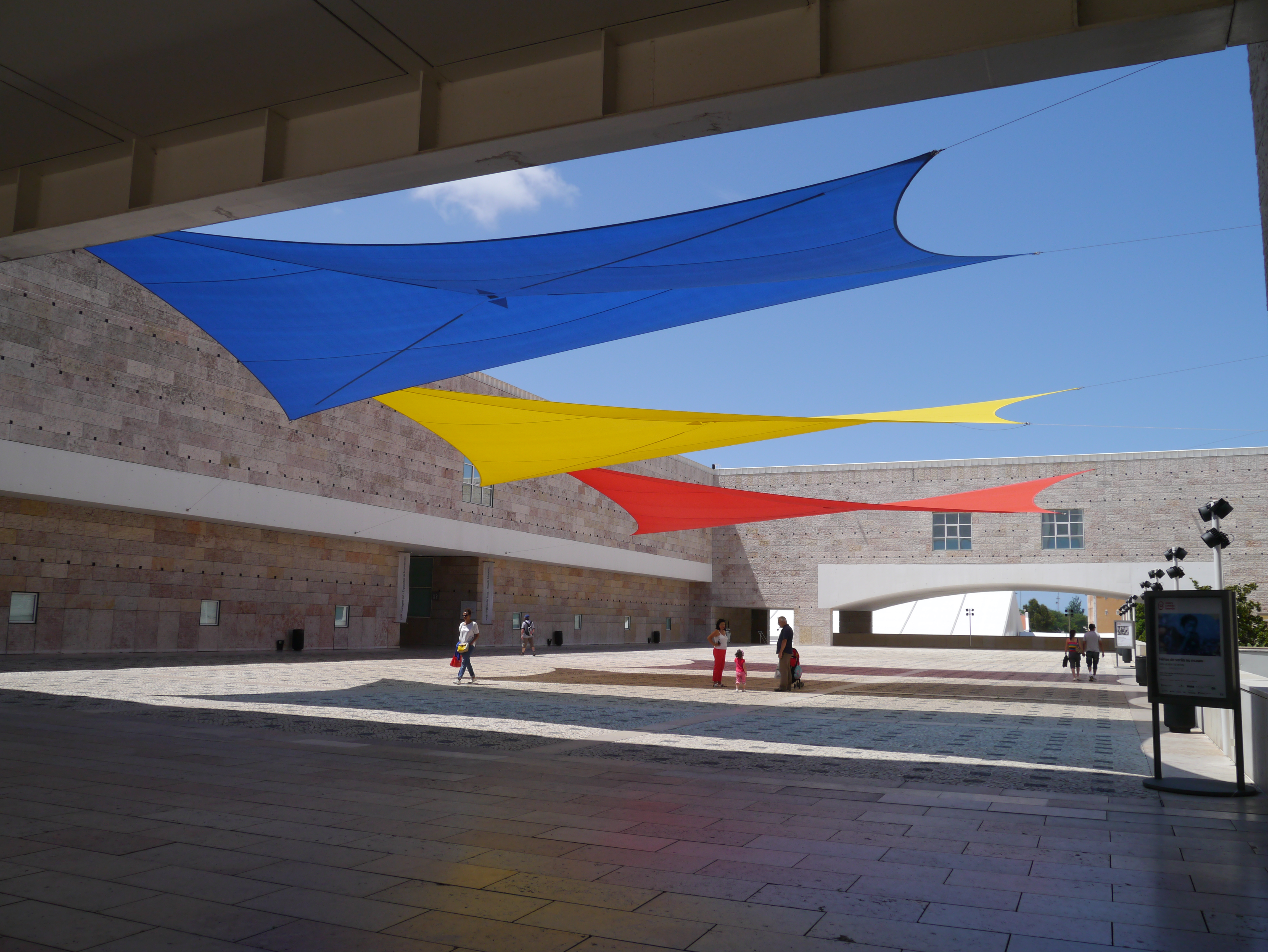
Our next stop, the Centro Cultural de Belem, which houses the Berardo Collection of twentieth century art, could not have been more different. Housed in a vast, but contemporary building the collection weaves an impressive narrative through the many artistic isms of the last century. Its emphasis was on displaying apt examples of the art rather than particular favoured artists, though the big names were certainly well represented. It was a treat to be able to look at such work in comparative peace without the crowds. The art was thoughtfully presented in spacious rooms, with lucid information in both English and Portuguese and the facilities were first rate. We also enjoyed the collection of advertising originals, displayed chronologically on the lowest floor.

Courtyard, Centro Cultural de BelemAfter our tour we ate sushi in their garden restaurant. Our table overlooked the towering Monument to the Discoveries, with Portuguese explorers sculpured mounting the prow of a ship.Monument to the Discoveries Ant like figures milled around the base and a few brave souls were mere specs looking over the parapet at the top. We decided to give this one a miss. We also missed the Torre de Belem, the museum housing filigree coaches and probably much more besides. John bought me an art book of the Berando collection, such a treat, and carried it home for me.

Posted in sight seeing | Tagged , , , , , | Leave a comment

Peniche to Cascais

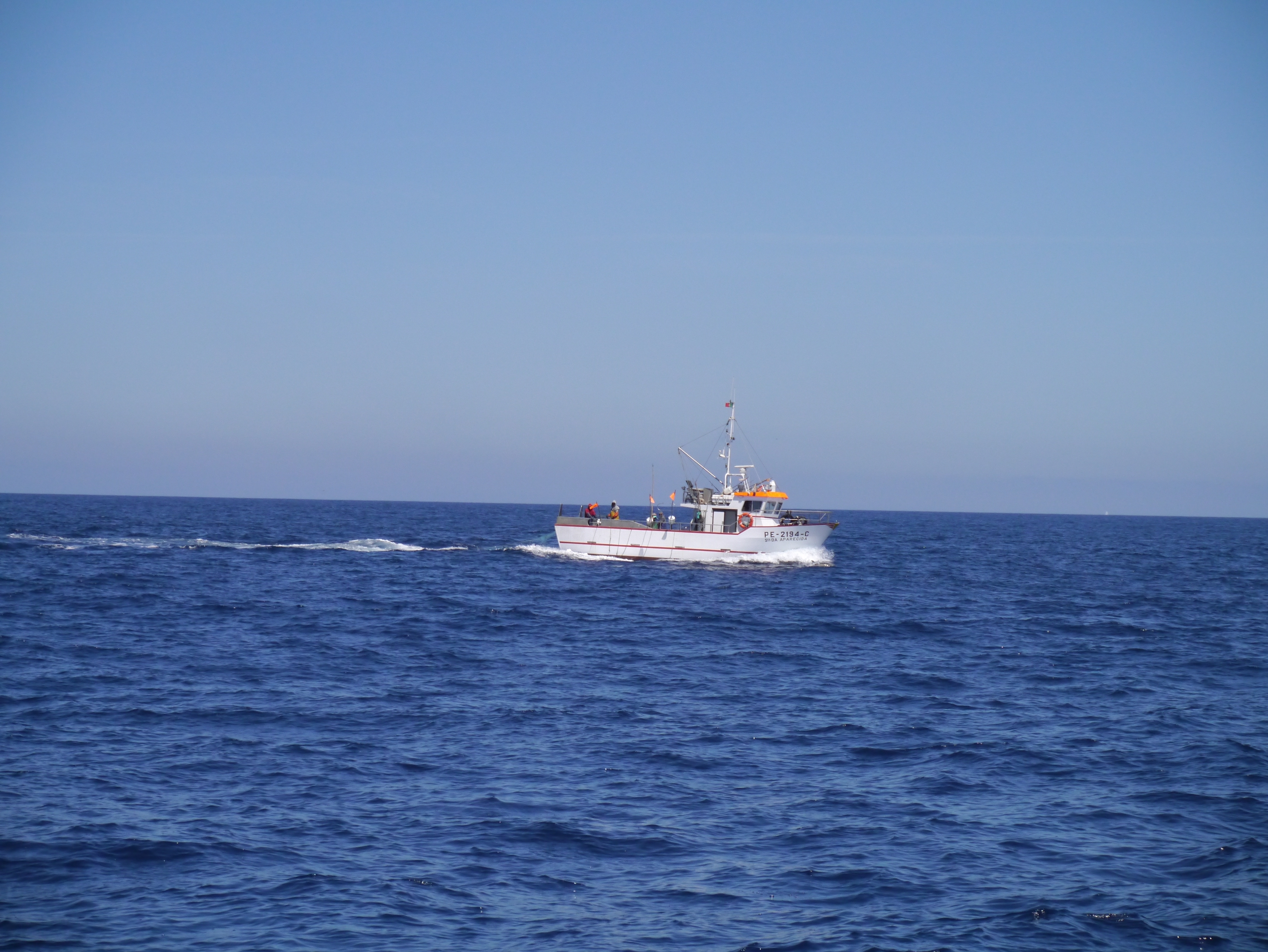
We were beginning to be rather blasé about the dolphins, waiting for them to show up as opposed to hoping that they would. At first we saw nothing on our way to Cascais, then John spotted a tuna and finally there was a big dolphin on our bow. We could see a few more in our wake. Cutting across the wake behind them came a yellow fishing boat.Fishing Boat John said I would get a good close up and sure enough I did. They were busy laying net. Hurling swathes of green nylon over the side to sink and form an underwater train. I felt sick at the thought of the dolphins and that net. Thankfully John soon saw them again, first the large one ploughing along at the bow, then the others cavorting alongside. They stayed with us for ages, our longest sighting yet. When we left them behind they were circling in our wake, obviously doing their own fishing well away from the net.

This slideshow requires JavaScript.

 Although the sailing was pleasant, we were zigzagging about making quite slow progress, so at around four we put sails away and the engine on, so as to reach Cascais at a reasonable time. As we turned in to the final stretch the wind blew up to force five and the surface became frilled with white horses. It was too late in the day to sail, so we motored into the shelter of the harbour and headed for the marina in the top left corner. It was another case of tie up outside the office and complete paperwork before heading off to a berth and again the pontoon was a hive of activity, but this time we had a helpful marinera to take our lines. He spoke perfect English and said he would also help us berth. He was as good as his word and sent us off with a request that we go slowly as he only had a bike. This is a huge marina and our berth L23 was right at the far end, near to the cafes and bars. As we chugged slowly along we could see our helper flickering between the masts, peddling hell for leather along the opposite wall, like Tony Curtis in “Some Like it Hot.” We rounded the corner by the wall on our side and peered about, trying to spot our berth. There he was, minus bike, waving at us. He helped settle us into position and then was off to do the same for the next boat.

There is a pleasant walkway from the marina into town, indeed a walkway extends along the coast and we had a gentle evenings wander along it, past the crowded beaches.

Bands of youths were lined up, daring to jump from the piers into the Springs high tide. One lad made an enormous leap into the sea right in front of us, but the ladies he jumped past gave him a hard time about it and proved even more fearsome than the drop. We have walked into town several times and explored the shops and stalls. There is a very up market area inside what used to be a fort, with a hotel and posh restaurants. There are some lovely looking bistros in town and many enticing places to sit out for a drink. There are even a couple of Irish bars and several Indian restaurants. After the hot days out our evenings have so far been spent either eating on board or in the marina restaurants. There are several to choose from and all have been good.  It is a very up market marina with a Riviera feel. They certainly know how to charge, but we have been happy with the service and it is by far the nicest place we have stayed so far in Portugal.

Posted in Beaches, sight seeing, Walking | Tagged , , | Leave a comment

We have heard the news of the tragic train crash near Santiago de Compostela. Our recent time there, when we travelled by train makes the awfulness really strike home. Our hearts go out to all those who have suffered and are suffering as a result of the disaster.

Posted in Uncategorized | Leave a comment

Figuria da Foz to Peniche

Another long passage down the coast of Portugal took us to Figuria da Foz, or Fig Foz as it says on all the boats registered there. This time we stayed closer in and the coast seemed to be one long beach with low land behind. The pilot book did not make Foz sound an enticing prospect. It spoke of vicious cross currents and the need to avoid the ebb tide, to preferably arrive at slack water. This is because Foz is in the mouth of a river and at the ebb the tide adds to the river current, which is a strong  one. The only alternative to Foz would have meant travelling nearly a hundred miles, leaving at dawn and going on till dusk. That was as the crow flies and made no allowance for sailing to the wind. So Foz it was and we had a slightly later start, as we wanted to arrive at around six in the evening.

Finally we had blue skies and a blue ocean and after a few hours we had some wind. The skipper went forward to wind out the mainsail, leaving the crew to winch. A large pod of dolphin came to investigate, big ones, small ones swirling and circling, rolling on to their backs, showing their gleaming white tummies. I think they were trying to watch what we were doing. The skipper had to have stern words with the crew, who was not really paying proper attention and kept letting the rope slip off the winch. Once the sail was up the dolphins stayed alongside us for ages. Unfortunately in my excitement I managed to press something on the camera, which gave the shots I took an even bluer cast, like the dodgy bits from South Pacific.

This slideshow requires JavaScript.

I also took some inadvertent video, but have no idea how too play it back. That day we had lots of long dolphin encounters, I think they like the shade cast by the sails. At one point we were raced by some little, fat dolphin, which leapt right out of the water with their bodies stiff, like cartoon characters and then went to play in the bow wave. John also saw an eel, which slithered snakelike across the surface, not so enchanting. Sailing along in the light wind with the music playing made the long day seem rather decadent.

Our arrival at Foz was spot on six and we coped well with the cross current on entering the harbour. We had heard no response to our radio request for a berth, but an official with an immaculate white short sleeved shirt was waiting outside the reception. He took our lines, but did not look very comfortable about handling them and was much more concerned that John should go with him to complete the paperwork before we went to a proper berth. This seemed a daft arrangement with everyone trying to enter at slack water, we knew at least two other yachts were coming in behind us and their masts were clearly visible behind the harbour wall. John went inside with him and it was not a quick process, despite John filling out the forms at such speed, he had nearly completed the Portuguese bits before the official could stop him. Meanwhile a two masted schooner was on its way towards me.  Finally John and the official emerged and he more or less told us to pick our own spot, he would be unable to assist. We shuffled off as the schooner pulled in. I stood poised on the beam, the pontoon was short and would prove to be wobbly, the current was manning up. I was saved from having to launch myself  by a small child. He stood bare chested and careful, waiting for our ropes. When he caught them he received a lot of earache in French from his dad, about what to do and when to do it. I thought he did a marvelous job and tried to say so and to thank him.

Not much later we set off into Foz. There was a long walk across the pontoons to the restaurant and bar. As we walked by fish swarmed like piranha slightly ahead of us. The bar was humming and the restaurant full of Reserved labels. We headed off into town, well actually just across the wide road, and ate at a small restaurant with a barbecue outside. A thin, mournful looking chef manned the grill, alternately shuffling coals and ashes and fanning wildly. Food was cooked without a word being exchanged with him. He collected metal plates of raw food from inside, he cooked what was on them, shuffled the plated a bit and then put the cooked food back onto them and took it back into the kitchen, from where it emerged arranged on pot plates accompanied by potatoes. Occasionally someone he knew came in and he broke into a wide smile and nodded. Out in the public car parking space in front a couple of youths were operating a “Look after your car Mister” routine. Next day there was a street market in which shiny hub caps and wheels were on sale.
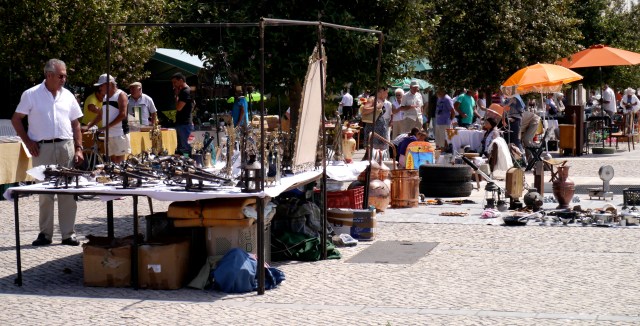
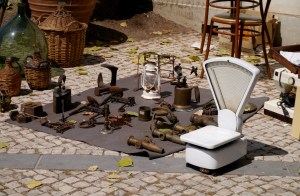
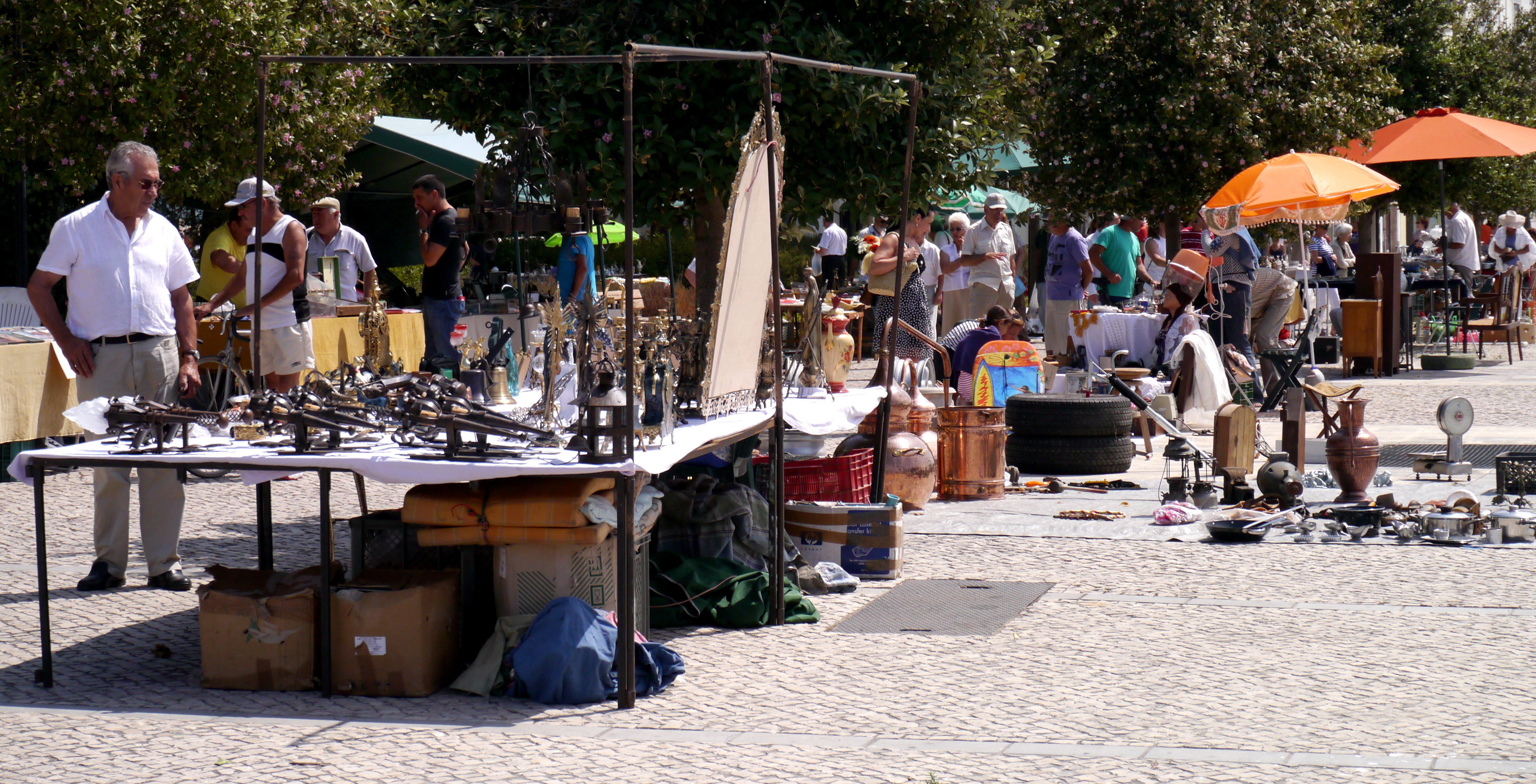
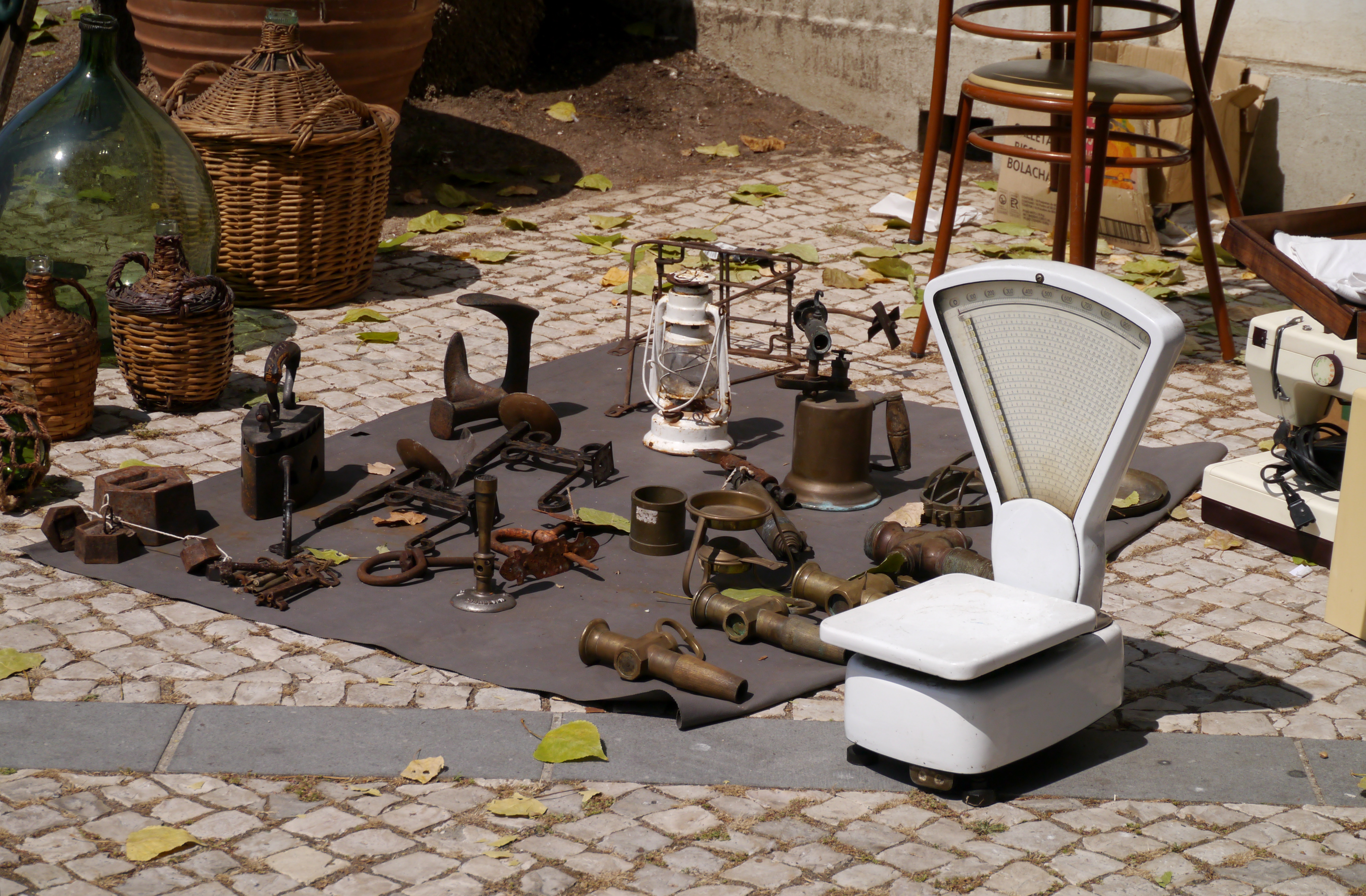
Market, FozMarket, Foz

We wandered around admiring the cauldrons and old sewing machines,  record players and wine flasks. Scythes and other lethal looking antique tools were ranked along with plaster saints and china teacups. Women clustered round the jewelry tables and old men sat in the shade chatting and eating what looked like baked shellfish from a steaming black mound.  We followed the crowds and found a wonderful market full of fresh vegetables and fish. It was a pity we did not need more, but we bought bread, cucumber and tiny tomatoes.

At intervals as we walked came a blaring burst of trumpets and a loudspeaker announcement from a touring car. At first we assumed a politician was canvassing for votes, but then we realised they were promoting a bull fight taking place later that day. The evangelical nature of the advertising made us wonder if such events were so popular. The visiting circus just made do with posters. We walked up through the smart part of town towards the sea, where Foz became quite a seaside town, the territory for bucket and spade holidays. Our next stop, Peniche was even more so. We only stayed a night, so only explored the main street, but it’s atmosphere reminded me so much of Mabelthorpe, though the magnificent seafood platter we ate in Peniche was a far cry from our own seaside fish and chips. The journey to Peniche was another long day, mainly motoring, with dolphins as light relief.
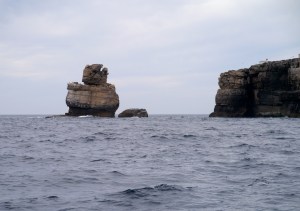
P1050674

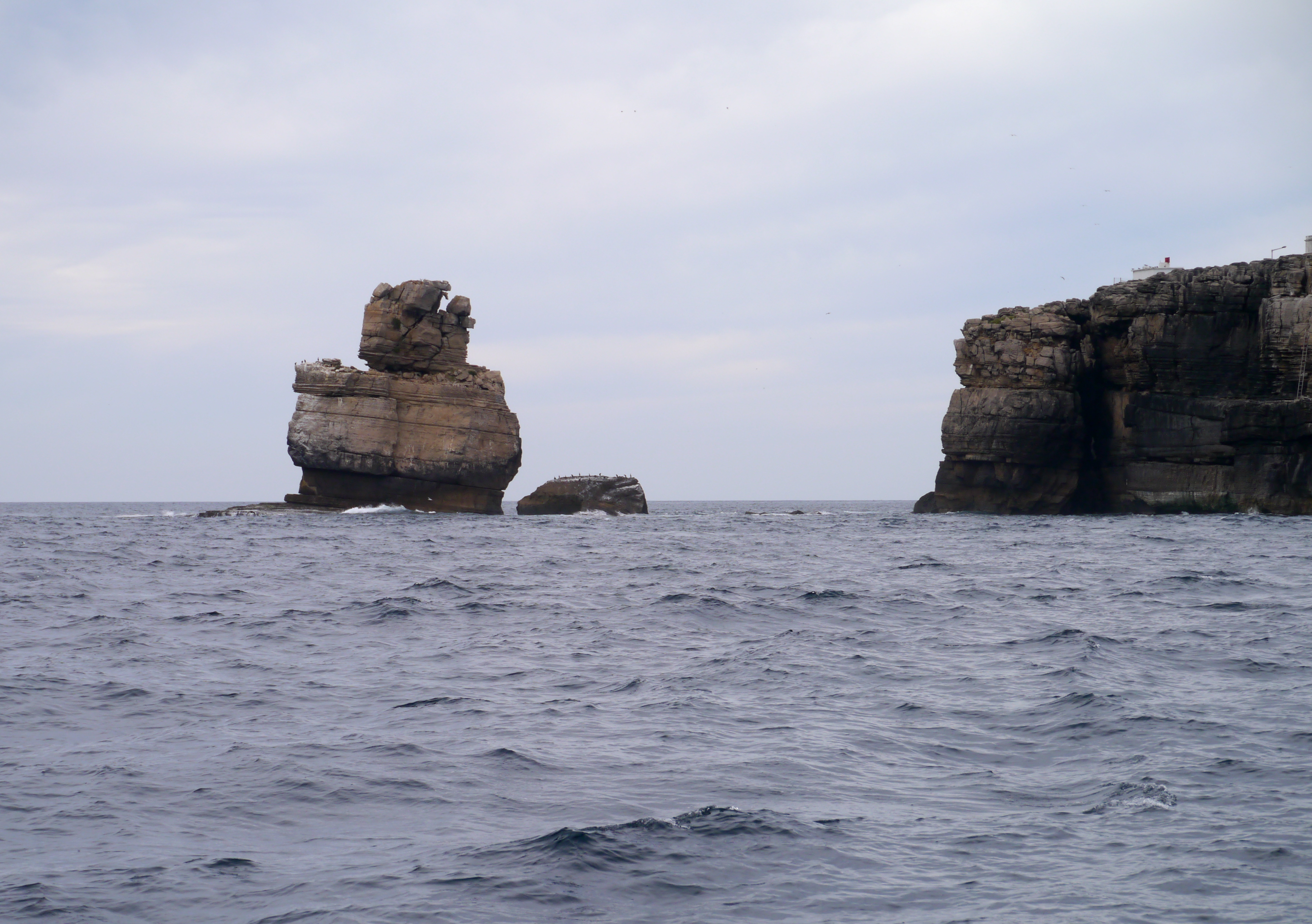
The corner of the coast before Peniche has a huge rock, shaped like a rubber duck. As we rounded it we could see a number of small pleasure cruisers full of tourists and gave way to a couple. The approach to the harbour was littered with lobster pots, through which John picked our way carefully. As we neared the entrance we were overtaken on the inside by a large green fishing boat, going hell for leather, trailing a canopy of gulls. Lyra road the first half of the wake and then we slipstreamed in behind them, coasting in along the milky, green passage they had cut through the slalom course of pot markers. Once inside there was room to go along the outside of the long visitors pontoon, which actually acts as a barrage to shelter the permanent berths.Marina, Peniche All night long we swayed in the slap of fishing boats plying to and fro. One night was enough. Fortunately our next leg was a shorter one, so we set out again next morning. As we rounded the harbour wall we were faced with a veritable minefield of small flags. The revenge of the seafood platter. John threaded our way through and them we had a go at sailing.
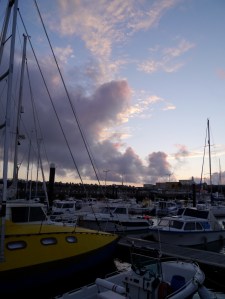
It took us a while to pick up as much speed as the force three wind promised and our progress under sail threatened to turn a shorter day into a longer one, so we gave up and put the engine on.

Posted in Sailing, sight seeing | Tagged , , , | Leave a comment

Porto

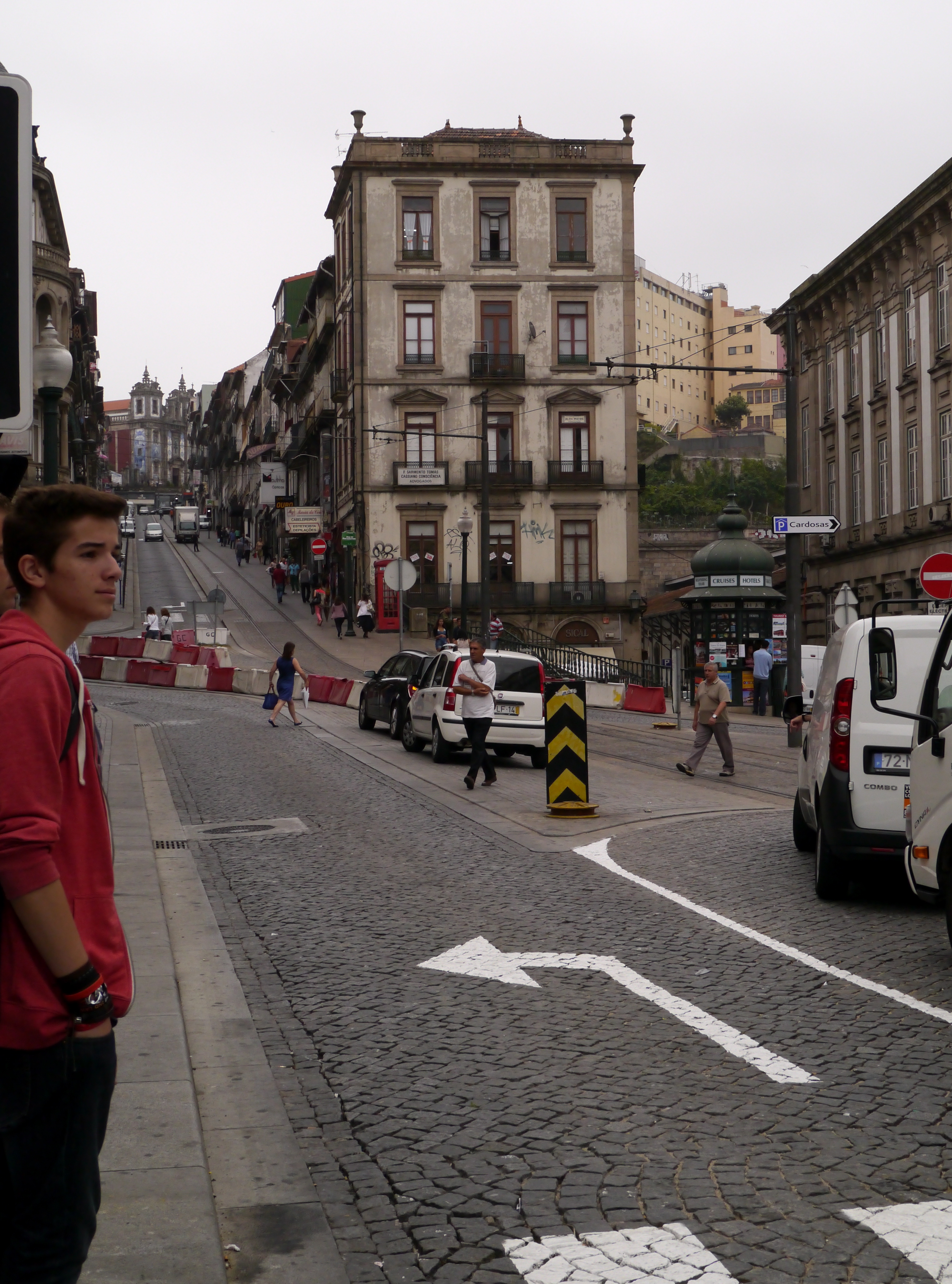
On Wednesday we planned to have a day ashore to visit Porto. John fancied seeing the warehouses of the port trade. We set off to travel by bus. After waiting at the bus stop a while we suffered from cold feet. Were we on the right side of the road? How would we know where to get off? Could we make ourselves understood? We set off back to the marina and had them call us a cab. The taxi dropped us off in the centre of town, which was suitably grand, with large stone buildings and the streets cobbled in shells, like Prague. We sat outside a café and watched the world go by over a couple of cappuccinos.  Several open topped tourist buses passed us by and we saw a wonderful old tram. Nearby a solo trumpet was playing the Godfather theme.P1040524

John knew the Port Cellars were down by the river, so after our coffee we set off walking down hill. Porto from the river was a different world from the staid granite of the main center. A patchwork of tall, narrow houses in faded Russian orthodox colours rose up the steep banks. On the opposite bank spread the Port warehouses, all the familiar names announcing themselves with large signs, which probably light up at nigh, a veritable theme park of port. Above it all a double cable car sent fat pods to and fro. On the river large gondolas swayed, each sporting a few picturesque barrels. There was a sense of Venice, but steeper and more shabbily chic.

The River Douro is spanned by six bridges in short order here and we took a boat trip to view them all.

This slideshow requires JavaScript.

All are spectacularly tall, the modern ones sleek and concrete, the historic pair arching and metal, one by Eiffel the other by his protégé, both bearing a strong family resemblance to the famous Paris tower. After the boat trip we visited the Sandeman warehouse, not because we particularly favoured the port, but because they had a tour in English at that time. We followed a girl glamorously turned out in the famous cloak and hat, past sultry looking barrels, glowing in the amber light.

The barrels were of oak and very old. The floor was tiled in small oblongs of oak and even older. It was kind to feet as well as barrels. The white and ruby ports were maturing in huge barrels, the tawneys in smaller ones, to allow them to take up more of the smokey raisin flavours of the wood. Ports are blends, aged in the barrel, apart from vintages, which are from a particular year and age in the bottle. Vintages are declared by an independent body and can be different for each house. In a distant part of the cellars bottles of the Sandeman vintages were kept under lock and key. 1955 was a vintage year of significance to us, but we shuddered to think what a bottle would cost and once opened its’ life would be fleeting, a matter of a couple of days. At the end of the tour we were free to sample from a generous selection, set out in elegant glasses on a sheet of white paper, which disingenuously urged us to drink responsibly. This we did. We left inspired with the urge to find out more about port and with a couple of bottles for good measure.

Then we had a late lunch and tasted a sausage acclaimed as “one of the seven wonders of the world.” It was certainly a very good sausage. Porto was an unexpectedly lovely place to visit, full of old world charm.

Posted in sight seeing | Tagged , , | Leave a comment

Farewell and Adieu to You Fair Spanish Rias

P1040386When we first planned to cross Biscay and sail to Greece, we had considered arriving in Baiona, as this would cut off the nasty corner with all the traffic and avoid the dreaded Finisterre. Bill, our instructor for the RYA Coastal Skipper theory, spoke fondly of the Spanish Rias and advised us to cruise them. We conceived the plan for a family holiday there, to strike out for La Coruna and a shorter Biscay crossing instead. We are so grateful to Bill for his advice. It seems inconceivable that we should have virtually missed Galicia. The whole place has been a delight and the Rias are a marvellous cruising area. I can understand how our neighbours in Cambarro fell in love with the Rias and never moved on. We did want to move on, though we may also want to come back someday. So on Tuesday at first light we cast off the lines and set sail for Portugal. We hope to see more of Spain next year as we head into the Med.

The weather was thankfully much clearer than of late, but there was still no wind to speak of, so we resigned ourselves to a long days motoring, which proved to be the case and rather tedious most of it was too. When we were about half way the fog returned, so we were both peering through the gloom looking for lobster pots, of which there were lots. We had motored a fair way out to try to avoid them, but this turned out to have been a fruitless exercise, so we headed back in to try to lose the fog. Fortunately there was little activity on either the AIS or the Radar.  I think I have already mentioned AIS, it is a system whereby boats who have signed up emit a signal and appear as a dart on the chart plotter screens of others. It provides a sort of Harry Potter marauders’ map for sailors. Click on the dart and a screen pops up with more data, what the boat is, how big, where it is going, how fast. We have tracked the progress of other yachts attempting the same passages as ourselves, their progress being reassuring. Sadly our friend Mike, with the concrete gaffer is not on the system, so we don’t know how he has managed the long stretches between safe harbours along the Portuguese coast. At least the weather has been good for some time, so there is little swell from the Atlantic to worry about.

Gradually the mist subsided and we looked out on a world painted in shades of grey, the ocean like a smooth, dark silk, rippling silk. As the sun came through the haze, the surface became mottled with texture and markers shimmered, which sounds pretty, but does not help when staring hard looking for the markers of lobster pot. Some pots are marked by tall, noticeable flags, some with a row of tattered wisps, like lances thrown down by natives in old time cowboy movies, harder to spot, others are just small buoys, polystyrene cartons or empty petrol cans, fiendishly difficult to spot, even in the calm sea. To add to the frustration are fat sea birds, which sit about looking like buoys and then flap away after you have altered course for them. By the end of the day I had floaters in my vision and was seeing flags where none existed.

What made the day special were the dolphins, dozens of them, which came surging towards us with great enthusiasm, to surf in the bow wave. They came out of  the mist and in the sunshine. They came with their young. Young dolphins leap into the air for the sheer love of it, like lambs. The parents keep the baby ones close between one another. We saw threesomes surface together, but with the tiny one breaking after the flanking adults, on account of their smaller size. Throughout the day we had some half dozen encounters with large pods, which had clearly sought us out, played a while and then moved on. John swears one leaned over and made eye contact. They lifted our spirits and kept us alert. I clicked away like the paparazzi, achieving a few scoops and a lot of shots of ripples and splashes.

This slideshow requires JavaScript.

We were glad to arrive in Leixoes, which is a huge industrial port, with a marina tucked into one corner. Two marineras were waiting to help us tie up and we headed off to the office with our papers. After that we both headed off into town for a beer. The town seemed rather seaside and modest, given the size of the port. It also seemed to be shut. A party from a Dutch boat were following us, obviously on a similar mission. After a while they gave up on us and went their own way. We found the Street of the Two Amigos. We could have done with a third amigo to tell us where the bar was. Eventually we found our way back to the beach and a Heineken sign. We looked in the deserted bar, where the patron was busy at his paperwork, but he came out from behind it and served us bottles of dark beer as the Heineken was off. What we had was most welcome and we sat out in a roofed open area, with a clever hedge to mask the road.

P1040638

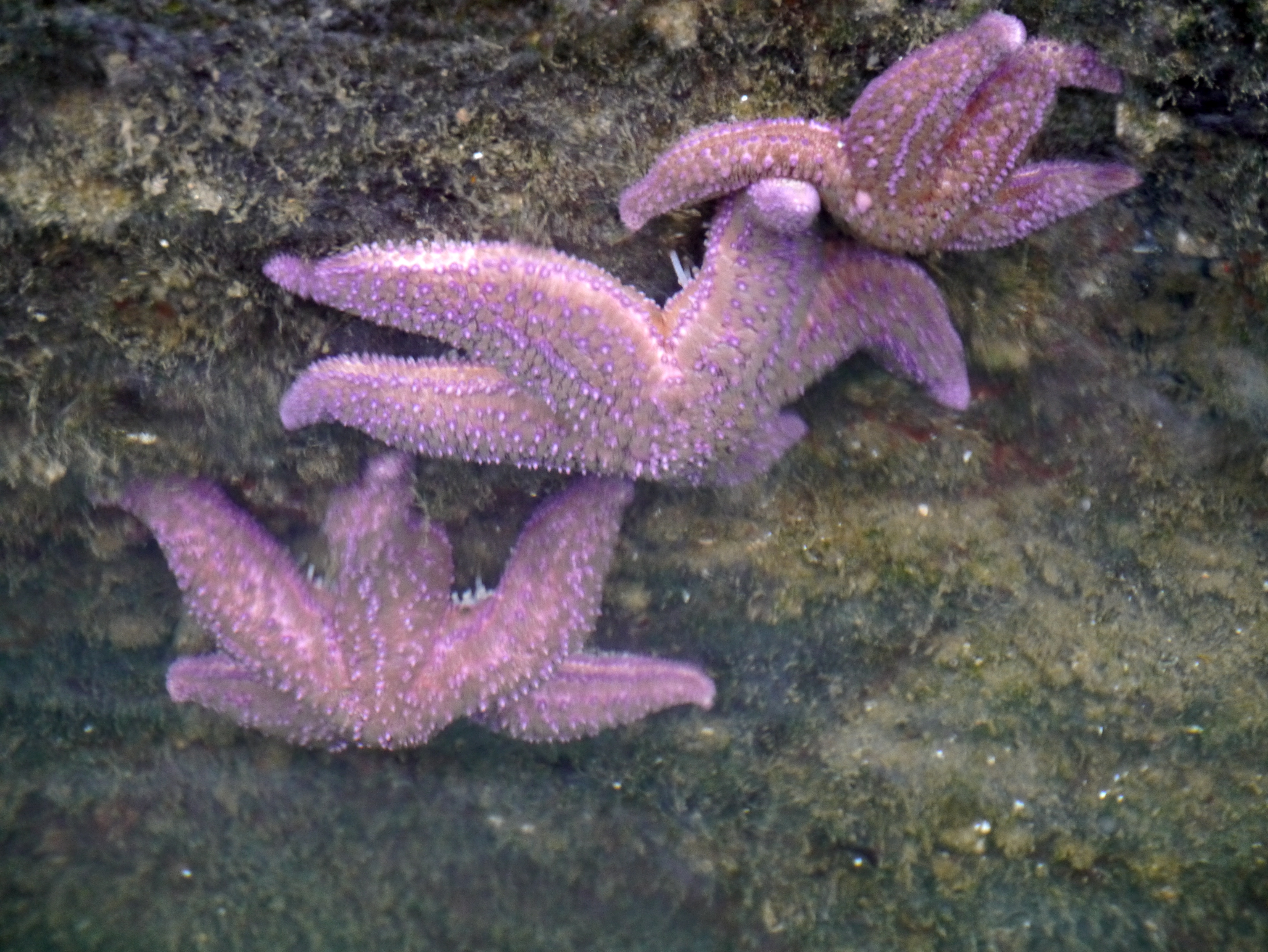
Refreshed we returned to Lyra to eat on board. Beans on toast, with balsamic vinegar splashed on, very gourmet, but a poor substitute for Hendersons Relish. On the way along the pontoon we were amazed to see pink and yellow starfish bunched in clusters along the harbour wall. Despite the industry the harbour water must be pretty clean.

Posted in Sailing | Tagged , , , | Leave a comment

Boom, Boom, Boom

Every Sunday in Galicia seems to elicit either the sounding of guns or the setting off of fireworks around mid day. Just lately this has been extended into the week. We heard the booming Monday morning, along with the sounding of foghorns and wondered if the shots were sounded to warn of the fog. As we were due to spend the day with an engineer, having a look at fixing our generator we did not really pay much heed. The generator was a worry. We had it installed by Berthon over the winter and had been running it at regular intervals, not because we needed it, but to keep it happy. On the morning we were due to set off home, four weeks ago, John tried to run the generator, to set it up for our absence. It would not turn over. He tried a few times, whilst I read the manual.  The manual was a gem of pigeon English, with some cute illustrations of the generator as Wagner’s Brunnhilde.  The only clear message was a dire warning against pulling water into the engine, at which point it made clear all bets were off as far as the guarantee was concerned. John was sure that as the engine would not turn over it would not be pulling water in. We e-mailed Berthon and they were much more helpful and thought the battery was not charged enough to fire the diesel engine. This sounded sadly familiar. We had lost track of yet another needy battery.  At this point we had to set off home, leaving Lyra with a faulty generator and a dodgy hatch.

The hatch had been another small mishap, just before we were due to leave. The hinges had snapped and John had ordered new parts to come to home and had fixed the hatch down temporarily, sealed with an application of plumbers grease, which seemed to have worked in the fierce downpours we then experienced.

We had been relieved to arrive back in Spain, primed with a battery charger and new hinge fittings and find all was as we had left it. John immediately set the generator battery to charge overnight. Next day the generator still did not manage more than a dry cough. John looked at the dipstick and found water in with the oil. Woe. We kicked the problems into the long grass till after the family holiday. On Sunday the holiday was definitely over and we had a go at the hinge, so that if we could not fix it we could present the engineer with the full calamity on Monday. The hinge repair was a bit fiddly, but all in all went surprisingly smoothly. We were less confident about the generator.

Two men arrived late morning. The engineer and his apprentice. They spoke no English, we spoke no Spanish and knew even less about diesel engines. Diesel engine maintenance was the one course we had not taken over last winter. I fear it is on the syllabus for next winter. We showed them the engine room. Being a centre cockpit Lyra has an extensive space under said cockpit devoted to the engine accessed by it’s own small door. The generator sits in the middle of this space. Men generally wax lyrical about our engine room, the amount of room, the access to the engine, virtually a chaps own shed away from home. I am not sure it has the same appeal after having been crouched in there a while. We pulled forward the companionway stairs to let in a bit more light and air. John chatted to the engineer through the gap and the apprentice took instructions and passed tools through the small door. They seemed to have an accord, there was a lot of tutting. Eventually the lad was sent off and returned with another young man who spoke English, Spanish and engine fluently. There followed a very thorough diagnosis, the outcome of which was that they were going to change the oil, then the engine might start, if not there were a number of suspects of varying expense and availability. If the problem involved spare parts we would be advised to leave well alone and wait till the winter layoff, after the oil replacement the engine would be ok to wait. They would go now for the oil and be back later.

Six o’clock that evening the first pair were back. The oil was changed, the cylinder flushed with some magic spray. The engine would not start. Back came the translator, they had done all they could, we all looked sad and resigned. We thanked them for trying and the two younger men left up the companionway. John rocked the stairs forward and the older guy was still in there, sat astride the generator, not a man to be easily defeated. He had John try the starter again and it almost caught. His assistant returned and there was further tinkering and spraying, two more false starts and then the generator throttled up and chugged away. Tantalisingly he stopped it and started it up again twice, just to be sure. Each time it sounded better. Our hero showed John how to top up the oil and use the magic spray and emerged triumphant. A huge worry lifted by one man’s persistence. What’s more, next day when we went to pay we were given a discount on our berthing fee, because we had had the work done there.

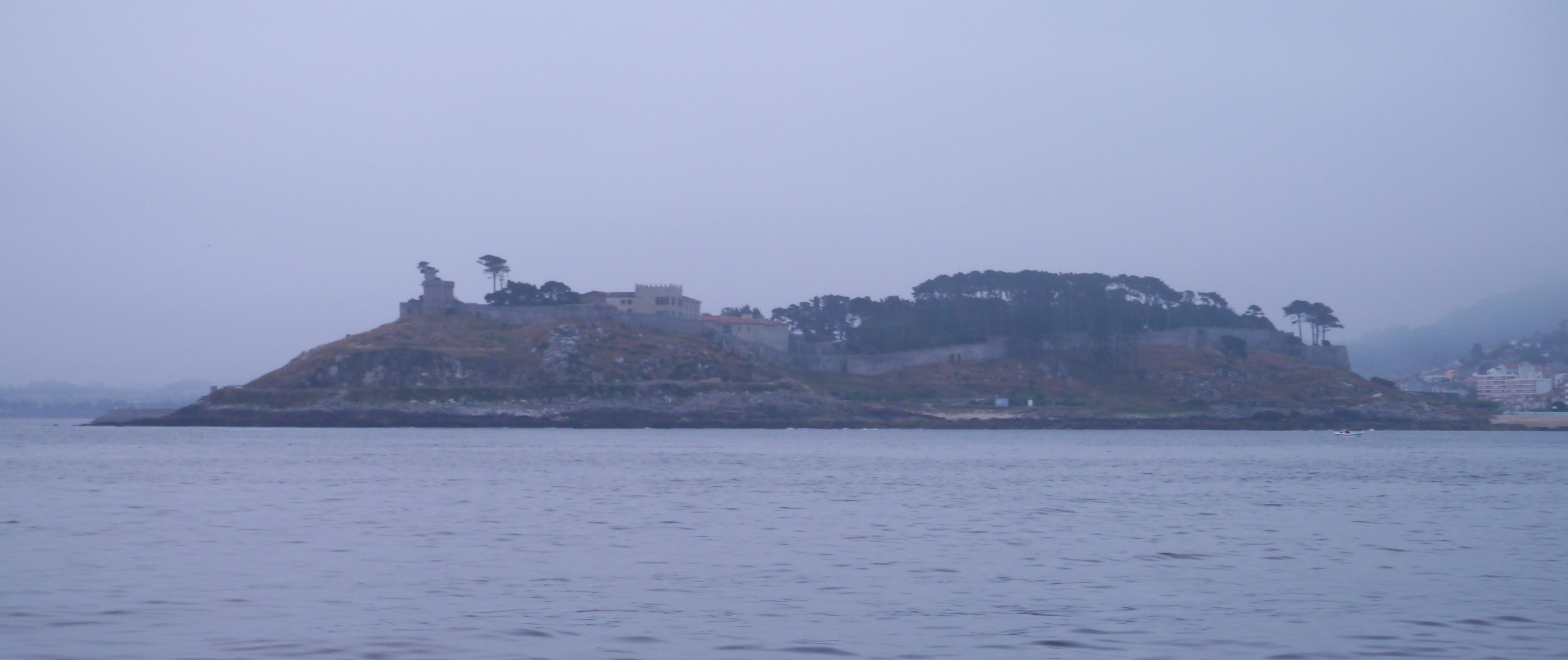
This allowed us to set off for Baiona on Tuesday. The weather was still murky, so we motored along slowly, taking the long way round to avoid the hazards. Baiona is set against steep wooded hillsides, and must be beautiful to approach when they are not shrouded with mist.

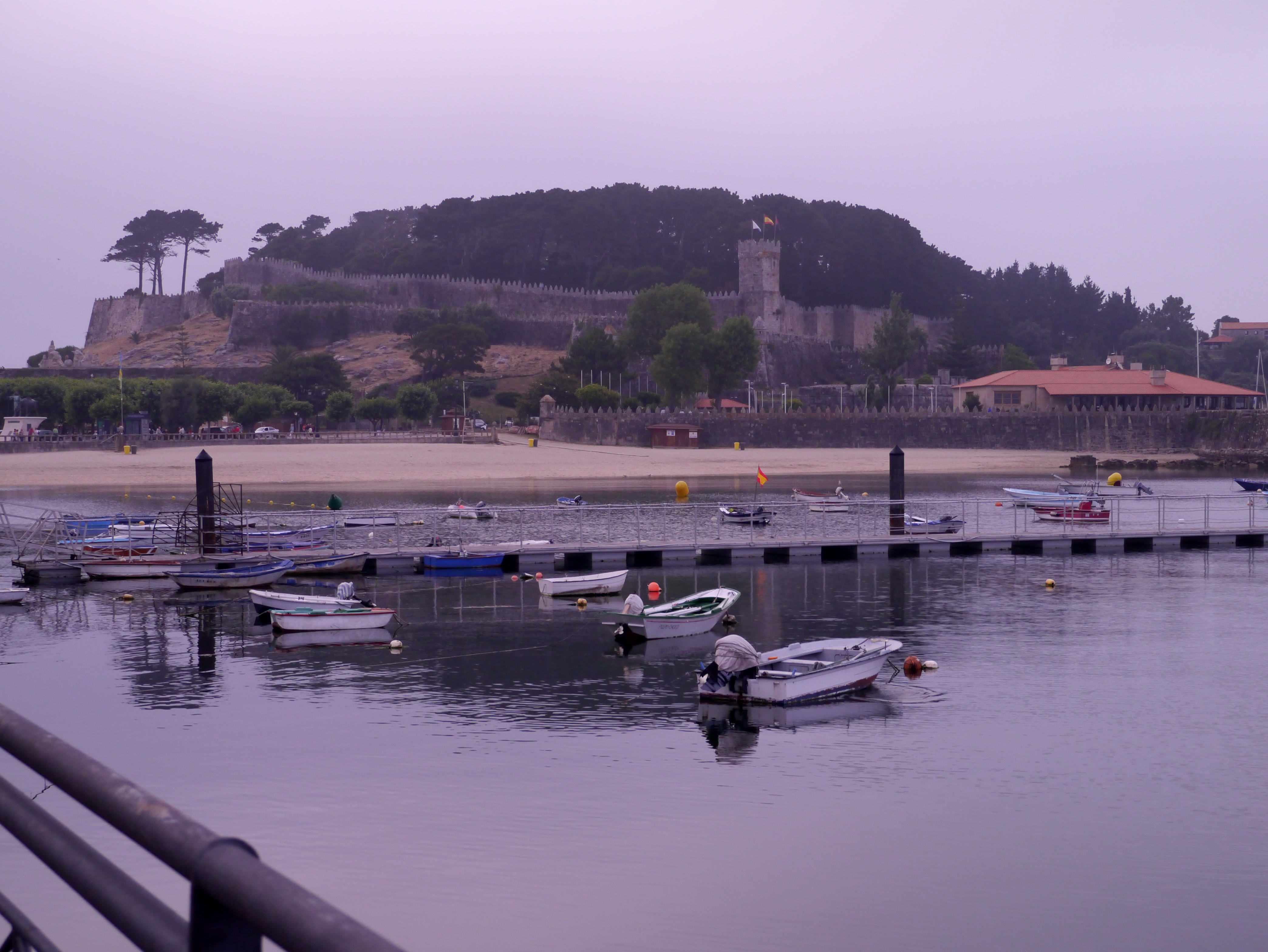
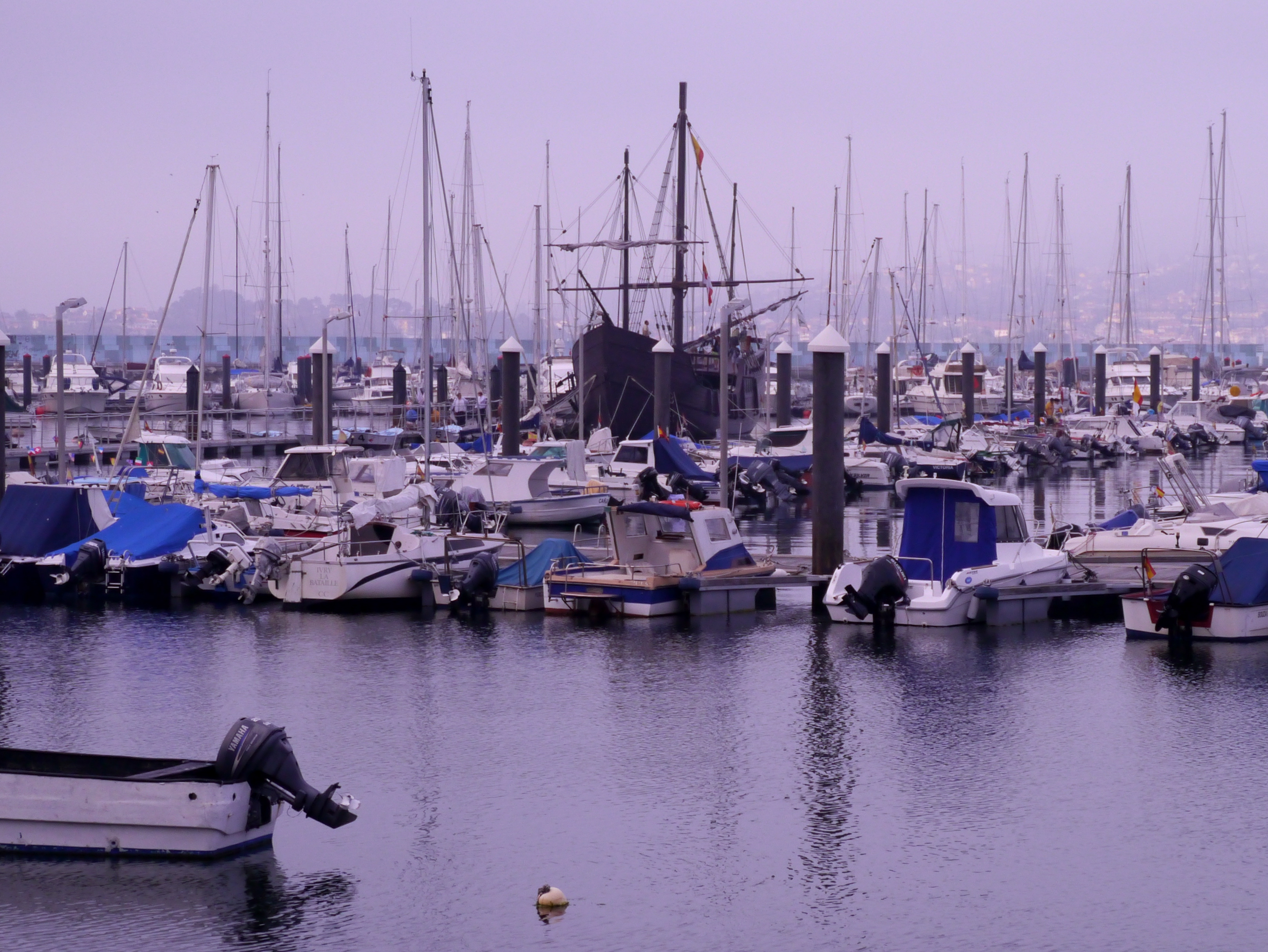
Castle Baiona On our arrival we could hear the familiar booming and fire cracker noises coming from the old fort. The girl in the marina office explained it was a holiday and the supermarkets were closed. We had a wander along the promenade and saw where a replica of the Pinta, one of Columbus’s three ships, jostled with the other masts.

Pinta replica

We walked round in front of the fort to see the rocks we had come past way out in the mist of the bay. We wandered through the narrow streets of the old town and passed an open doorway through which was a splendid altar. Just beyond this a stage had been set up and plastic chairs were being set out in rows. The streets around were thronged with people drinking outside bars and children playing. It reminded us of Weymouth on the bank holiday back home. We found a quiet restaurant up a side street and had just ordered when the booming began in ernest. It was like a very slow, rather uneven twenty gun salute. Then came the sound of bagpipes and drums. A procession was winding round the streets around us. We saw it pass the end of our alley. First silver lanterns carried by children, so that they wobbled precariously, then the pipes and drums with elaborate feathered head dresses, then smart men in suites, then a huge effigy of the Virgin all in white on a bed of white flowers carried at shoulder height leaning forward precariously at a rakish angle and finally a brass band playing soulfully. The music reminded me of the old John Wayne film about the Alamo. We discovered later it  is a ceremony in which flowers are spread on the sea and the Virgin paraded to commemorate fishermen every year on July 16th.

Today the booming has stopped. It is not a holiday and the weather has been glorious. After the holiday the shops were packed, so the food shopping left John traumatised. We had a lazy lunch and later walked up and around the fort. The views were spectacular, the battlements were littered with the cardboard remains of fire crackers. We also saw the old canon pointing out to sea, still there to repel invaders. Our plan is to stay on board tonight, for tomorrow we are off to Portugal.

Posted in Boat problems, Sailing, sight seeing | Tagged , , | 1 Comment