
When we arrived it was definitely not totally tropical. The sky and sea were painted in shades of grey, the sea slick and oily and the clouds bunched and threatening. Even so the party started as we motored into Sant Antoni harbour. A deep penetrating thrum of rhythm started up, reminding me of life at home when our neighbours’ son Michael and I were teenagers. The weather was in sharp contrast to the blue skies and wall to wall sunshine of the last time John and I came to Ibiza nearly thirty years ago. We joined my parents and brother for the October half term week, gatecrashing on Mum and Dad’s holiday. When John and I arrived the three of them were well on their way to going native. They sported impressive tans and wore brilliant white T-shirts with fluorescent logos. They were buzzing with places we could go and things we could do, some they had experienced and others they had been saving till we arrived. We soon caught them up in the tan department having a vestige left from a summer spent trekking in India, as a consequence of which we were also skinny and fit. Another sharp contrast between then and now. My parents were slightly younger than we are now and, looking back, enviably skinny and fit themselves. David had the most even suntan I have ever seen on anyone before or since, the result of a meticulous turning process we were to subsequently witness on the beach. Cala Longa, we all spent a good part of most of our days on that beach. We have good memories of the island, though I do not remember visiting Sant Antoni before. The conical pine covered hills were much as I remembered and the resort is not so high rise as I had feared. After our long day we did not think the reverberating drum beat would disturb our sleep.


We left the Columbretes just after dawn, motoring into a spectacular sunrise in the open gap to sea. The water was choppy even though there was still no wind, but we hoped to sail at some point. From this side the Columbretes strung out behind us like teeth, the one where we had anchored cast as a giant molar. As the day wore on the wind was conspicuous by its absence, though the up side of this was that we could progress at a steady seven knots in a direct line to our destination. Visibility decreased slightly and we turned on the radar overlay when we noticed the blue darts of two fishing boats on the AIS. It was difficult to see a radar trace from either of them, so we turned up the sensitivity and John changed course to go behind them. Suddenly more darts popped up like rabbits from a magic hat. We jinked between them, increased speed to eight knots to go beyond them quickly. Then we encountered a couple of cargo vessels forging along. The passage was tedious, but not uneventful.


The big bonus of the fishing fleet being out was the number of dolphin we saw. We have never seen so many groups in a single day. There were a mixture of small shiny dolphin, bounding beside us and larger darker ones with tiny babies breaking the surface a distance away. A few adults would come alongside and jump into the bow wave, weaving in and out from one another, turning over conversationally under the water. At first we worried we would lead them into the fishing nets, but they broke off before the fishing boats were anywhere near. After a while I began to think they were cleverer than that. Each fishing boat seemed to have a corresponding school of dolphin, gently circulating at a distance. Although they came along with us a way they did not venture close to the boats. I think they associated the fishing fleet with fish finding and tracked the fishermen, poaching from their catch. Perhaps their own echo sounding could pick up the fish finding radar. I am more certain that they jump in order to have a good look at us. When we see dolphin going about their business at a distance they all merely break surface to breathe and yet as they approach us or go alongside they jump high into the air. I think they are people spotting. They lose interest in us before we tire of their company. They brought joy into our long days motor.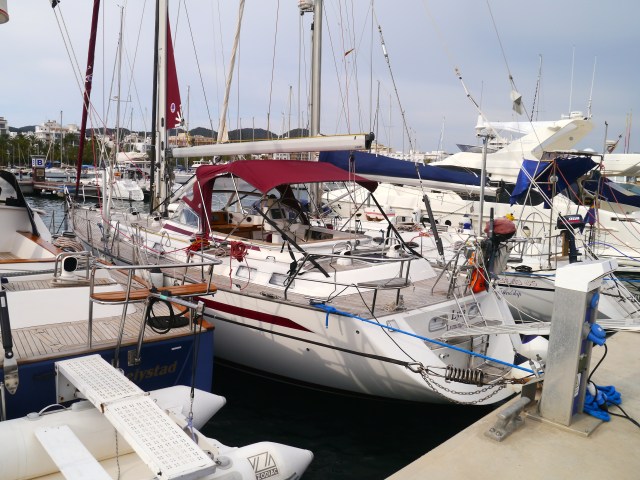
Now we are squeezed in between an unoccupied blue boat of similar proportion to Lyra and a low white boat called Friendship, whose occupants popped up like meerkats on our arrival, but disappeared below after talking to the marineras. There were two marineras to help us in, we saw them cycling along the pontoons, as we arrived pointing ahead along C pontoon. We had been allocated C for Charlie 16, we hoped not to make right Charlies of ourselves with the mooring. We need not have worried, for all went well. John reversed in and I held back, despite gestures from the bald headed one to throw the windward line, until I knew I could throw the rope the distance. I then captured the lazy line from him with the boathook and passed it across to John. As John headed down the starboard side threading the lazy line I threw the port rope at the good-looking, younger marinera and hooked a second lazy line from him. He helped me by pushing the boats apart smiling throughout, as I wrestled the slimy lazy line past our assorted fenders. I smiled back and thanked him, but reflected that I would have probably been disgruntled if the bull headed older man had been grinning indulgently at me. I would still have thanked him though. John came to my side and took over the line and with a touch more reverse we were set to lower our drawbridge and explore ashore.
 The late start allowed us to join in the early part of the beer party held in the club the previous evening. The party went with a swing, John tried the bottled beer and we chatted to folk berthed along our pontoon, which was both pleasant and informative, as they all have experience of the islands. I was particularly keen to pick up tips on catching buoys, because Lyra is much more high sided than anything else we have sailed in. Unfortunately each couple we spoke to favoured a different method. Paul and Dawn reversed onto the buoy, picked it up astern, then walked it forward. Jeanette lassoed buoys from the bows and the waited for Peter to come up and help manhandle it. We have not used either of these techniques before, catching our buoy on Windermere with a boathook. I had a worrying number of unfamiliar options. This morning when we finally came to set off a couple of the guys we had been talking to at the beer party kindly came over to give us a shove off, which was most welcome.
 We were about an hour out and John said that if things did not work out here, it would be too late to carry on and we should head back to Burriana, which was closer. Our last visit to Burriana with the girls had been depressing. There had been plenty of room there, which we could understand given the ambiance of the place made the converted fish dock at Cadiz seem chic. There had been several small restaurants and a bar, but all were apparently fully booked. After a couple of cocktails in the bar we had cooked on the boat and watched the world cup final on TV, which was a disappointment when the girls were on holiday. The prospect of another five hours motoring back there did not make my heart beat faster. I hoped fervently there was a free buoy and that I was up to catching it.


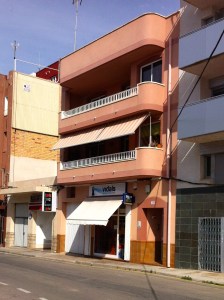 When we are not responsive it wolf whistles. We do not think there is any connection between Vidal and the apartment above his shop. He is a quiet spoken man with a very good command of English and an impressive ability to decipher John’s drawings. He has ordered us a rope with a metal eye for the extra stern anchor, which is increasingly looking like a vital piece of equipment. Vidal’s shop is a very well ordered place, but time runs slowly there. The rope has yet to arrive, probably by tomorrow. No, he no longer deals in gas. He fingered through a pile of papers and came out with a hand drawn map, which he was clearly not planning to relinquish. He explained how to go from his shop to the shop with the gas. There would be no sign to the shop and no symbol for gas. There would be a door between two windows in a building between two side streets, just after the turning to the big square with the fountain. We could not miss it. Whether the man would be there or not, shrug, Vidal could not say. Off we went.
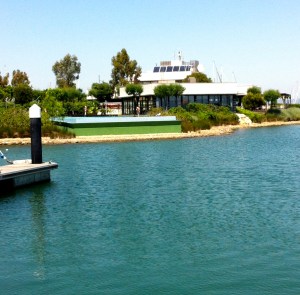
 Arriving back from the washrooms this morning, I discovered John at the end of the boat rapidly disappearing behind the dinghy he was busily inflating. Dinghy trial today, I thought. We have yet to use the dinghy in anger, but went on a trial run last year. Trial being the appropriate word, when it had come to my go. Today was obviously the day for a repeat performance. We had breakfast first. In the time it took me to wash up and brush my teeth John had assembled the electric outboard and was sitting waiting for me in the dinghy. This time he had assembled the seat, which made it all very civilized. I clambered aboard and he took me for a spin. A relatively quiet one, just a few Clanger noises as John revved occasionally. There was none of the jolting drama of our first trial and we made a very pleasant circuit of the marina basin. It is surprisingly large. We made our way back to Lyra and it was my turn. The seat was a bit of an obstacle when it came to changing places without tipping over and I had an uncomfortable moment with one of the rowlocks, but we managed it. Off I set, steering more or less where I wanted to go. John commented on the silent running at this speed, so I speeded up to full throttle fridge roar. We still did not disturb the slumbering seagulls on the jetty. Mine was a shorter tour of just part of the basin, as yachts were beginning to set out and I was not keen to test my prowess too far. Back to base, and I managed to dock on the second attempt. Climbing back out past the seat and up onto Lyra’s stern was a challenge, but again all passed off without a splash. John passed me up the electric outboard a piece at a time and we congratulated ourselves on a successful sea trial. Tomorrow it will be the real thing. We plan to take Lyra out into the lagoon and anchor there.
 The Voyages of Lyra